

Sub-Theme
Building Technological and Community Relationships
Keywords
AI-assisted, AI-resistant
Category
Paper Presentation
Introduction
The infusion of AI-generated content is increasingly prevalent in education, raising concerns about assignment authenticity and potential impacts on student learning quality. This study documents efforts to engage educators and students in exploring effective strategies for integrating AI-generated material into teaching and assessments, ensuring both academic integrity and meaningful learning outcomes.
Literature Review
The integration of artificial intelligence (AI) into education has transformed assignment design, prompting both innovation and concern. Tools such as ChatGPT, Claude, and other large language models (LLMs) offer unprecedented opportunities for formative feedback, idea generation, and writing assistance (Zawacki-Richter et al., 2024). When strategically implemented, AI can foster deeper engagement by enabling personalised scaffolding and iterative learning processes (Chiu & Rospigliosi, 2025).
However, the authenticity of student work is a growing concern. As students increase their reliance on generative AI, their ability to demonstrate original thought may be compromised. This challenges traditional notions of authorship and assessment validity. At the same time, novel approaches to assessment have emerged, such as designing AI-resilient tasks requiring critical reflection, iterative peer review, or real-world context that AI cannot easily replicate (Cotton et al., 2024). Studies have shown that assignments that integrate AI-supported drafting, followed by reflective revisions, lead to improved metacognition and writing quality (Abinaya & Vadivu, 2024; Panke et al., 2024). This approach shifts the narrative from deterrence to empowerment, preparing students for AI-integrated futures.
The adoption of AI-generated tools across educational institutions can be uneven, reflecting the diverse pedagogical practices, disciplinary norms, and technological readiness of each academic field. Educators have varying needs and expectations when integrating these tools into teaching and assessment, highlighting the importance of context-sensitive approaches to support meaningful and equitable implementation. As such, this study seeks to identify common concerns and issues encountered by educators when trying to infuse AI-generated content into teaching material, as well as to explore how collaboration between different stakeholders can enhance learning.
Methodology
The approach to collecting information on the development of AI-infused assignments is largely opportunistic, comprising of (i) courses taught by me, (ii) surveying educators from NUS via the Center for Teaching, Learning and Technology (CTLT) Affiliates Programme (CAP), as well as (iii) surveying educators outside NUS.
(i) Explorations from Coursework
AI-resistant assignment
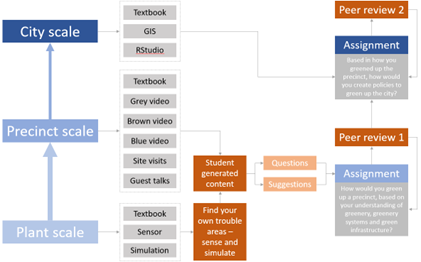
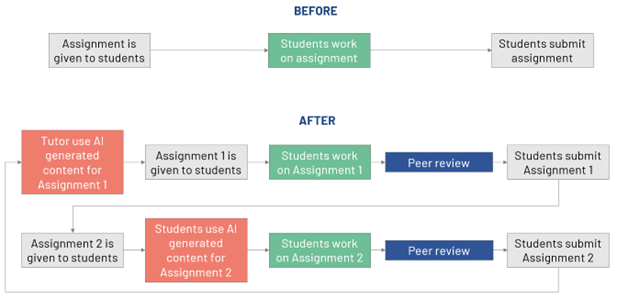
For the course LAD4012 “Urban Greening: Technologies and Techniques”, the original assignment was broken down into a series of smaller components, consisting of video assignments and peer reviews. Students were instructed to use ChatGPT in the earlier weeks of the semester to develop a structure for the report, but had to make changes to the content and contextualise their analyses by referring to the video assignments done by their peers. Two rounds of peer reviews were conducted so that students had ample opportunity to improve on their report. A survey was conducted towards the end of the semester to give students the chance to critically evaluate the quality of the peer reviews received as well as articulate how the act of reviewing the draft reports from others may have influenced their own writing/editing (Figure 1). This approach was adopted from work done by Dr Liu Mei Hui, who shared her approach in the presentation “Using a Draft-Rework Peer Feedback Approach to Engage Students on a Scientific Written Assignment” during the ITB-NUS Sharing Session on Engaging Students for Enhanced Teaching and Learning in February 2024.
.
AI-assisted assignment
For the course LAD2005 “Introductory GIS for Landscape Architecture”, ChatGPT was used to create a large geospatial dataset (buildings, shops, tenants, etc) and a list of suspects for a murder mystery (Figure 2). AI-generated software was also used to create pictorial clues to facilitate investigation. The use of AI-generated content dramatically sped up the production of the assignment. Details of the assignment can be found here.
.
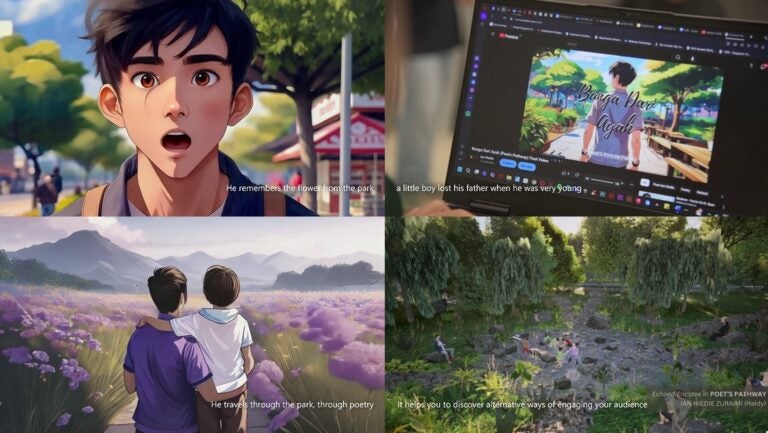
For the course LAD3001 “Design 5 (Landscape Architecture Design Studio)”, students were tasked to develop design solutions for Gillman Barracks. This design studio emphasised on the use of digital tools and AI-generated content for ideation as well as visualisation of the final proposed design (Figure 3).
.
(ii) Survey of Educators from NUS
The experience garnered from the various courses provided the basis for offering consultation to colleagues in NUS. Through the CTLT Teaching Affiliates programme, I was able to work with colleagues from different faculties to understand their respective teaching objectives and provide bespoke suggestions incorporating the use of AI. The consultancy was offered to participants of the Course Design Institute (CDI). Several participants took up the offer to develop AI-generated assignments. Through the interactions, I was able to suggest possible methods to incorporate AI-generated content into their assignments, as well as to gain insight into their views on using AI-generated content for creating assignments.
A workshop is scheduled to take place on 20th August. If possible, I intend to append more information after the session.
(ii) Survey of Educators Outside NUS
There is an ongoing engagement with Queenstown Secondary School to conduct workshops relating to AI-generated design with students under the Applied Learning Programme on 24 June 2025, as well as meeting with teaching staff to discuss opportunities for infusing AI-generated content for teaching on 19 June 2025. If possible, I intend to append more information after the sessions.
Preliminary Results
Data collection is ongoing and expected to be completed by August 2025. Nevertheless, some preliminary findings are as follows:
Varying Ease of Infusion
During the surveys with NUS educators, it became apparent that the ease of incorporating GenAI tools varied drastically amongst different disciplines. For IT and engineering assignments, most educators were able to clearly articulate the use of AI-generated content into specific portions of their assignments. For educators in the arts, medicine and design disciplines, incorporation of AI-generated content was not as straightforward. The emphasis for the latter was more on the understanding of concepts and less on technical competence. There was a wider range of responses anticipated for such assignments.
Preference of Non-generative AI Tools
Although the use of GenAI tools would seem attractive at first, there was a tendency for students to stop using it after a certain point. Arising from the limitations of GenAI tools (mainly consistency in generated content), students actually preferred to use more conventional 3D modelling, rendering, and video editing software.
Similarly, educators were observed to prefer sticking to more traditional approaches of assignment development. The use of GenAI tools was not critical to the learning objectives and often only played a minor role in the assignment. In fact, some educators opted for the use of more non-Gen AI activities such as peer reviews or contextual assignments using video or audio, to minimise abuse of GenAI content by students.
Common Concerns
There were several concerns that impeded the use of AI generated content or tools for assignment development. Firstly, several educators raised the issue of technical competency when operating the AI generated tools. For this study, the categories of tools surveyed ranged from (i) text-to-text, (ii) text-to-image, (iii) text/image-to-video and (iv) text-to-sound. Most educators were using text-to-text generation as it was most intuitive. There was much apprehension for the other methods as more settings and customisation were required.
For students, one major issue was the requirement of credits for generating image or video content. Most platforms only offered limited free trials and this had an adverse effect on usage. Generation of video content also took a significant amount of time, which led to delays in submission for some students.
.
References
Abinaya, M., & Vadivu, G. (2024). AI tools for efficient writing and editing in academic research. In Utilizing AI Tools in Academic Research Writing (pp. 141-157). IGI Global.
Chiu, T. K., & Rospigliosi, P. A. (2025). Encouraging human-AI collaboration in interactive learning environments. Interactive Learning Environments, 33(2), 921-924. https://doi.org/10.1080/10494820.2025.2471199
Cotton, D. R., Cotton, P. A., & Shipway, J. R. (2024). Chatting and cheating: Ensuring academic integrity in the era of ChatGPT. Innovations in Education and Teaching International, 61(2), 228-239. https://doi.org/10.1080/14703297.2023.2190148
Panke, S., Oeeshi, I. J., & Ahmadi, S. (2024). Generative AI in teacher education: Emerging pedagogies for collaborative writing. EdMedia+ Innovate Learning,
Zawacki-Richter, O., Bai, J. Y., Lee, K., Slagter van Tryon, P. J., & Prinsloo, P. (2024). New advances in artificial intelligence applications in higher education? International Journal of Educational Technology in Higher Education, 21(1), 32. https://doi.org/10.1186/s41239-024-00464-3