

LIEU Zi Zhao1*, Akshay NARAYAN2*, Marissa E Kwan Lin3, Verily TAN Siew Leng4, Lisa F. BRENNAN5, Jihang YU6, and CHONG Yuan Yi7
1Department of Biological Sciences and Special Programme in Science, Faculty of Science (FOS), NUS
2Department of Computer Science, School of Computing (SOC), NUS
3Centre for English Language Communication (CELC), NUS
4Centre for Teaching, Learning and Technology (CTLT), NUS
5Department of Pharmacy & Pharmaceutical Sciences, FOS, NUS
6Department of Materials Science and Engineering, College of Design and Engineering (CDE), NUS
7Department of Chemistry, FOS, NUS
Sub-Themes
Building Learning Relationships
Others
Keywords
Educational video production, faculty pedagogical challenges, AI in educational video production
Category
Paper Presentation
In this work, we examine the challenges faced by higher education faculty in implementing blended learning within a research-intensive university. In particular, we focus on educational video production for use in course teaching. Our literature review has highlighted that the use of educational videos in course teaching have been shown to enhance student learning and engagement (Fisher et al., 2021; Sahni, 2019). Furthermore, faculty members are aware of the benefits of incorporating educational videos into their courses. However, not all faculties are keen and based on our literature review, we find that several barriers have been reported that inhibit faculty from adopting educational video production in their courses; these include the lack of technical know-how in educational video production, lack of resources such as faculty time, software, and institutional support, etc (Porter & Graham, 2016; Kintu et al., 2017; Boté-Vericad, 2021; Ocak, 2011; Brownell & Tanner, 2012). Our research aims to identify the key challenges and barriers at our institution to developing and producing educational video content. In particular, we aim to investigate the following research questions:
- What are some of the faculty challenges and barriers associated with developing educational videos for blended learning?
- What are some of the challenges that faculty faced when producing blended learning materials for their courses?
To achieve this, we developed a survey based on our literature review and administered it to faculty members from various departments. The result of the survey was analysed, and the main findings were identified.
Faculty members are generally positive about the potential of educational videos to enhance student learning
Our survey results showed that more than 70% of our respondents agreed that educational videos help students learn better, especially abstract concepts, and are considered an effective tool for achieving the course’s learning objectives (Table 1). Faculty members view educational videos as a means to accommodate diverse learning styles and empower students with control over their learning pace and mode.
Faculty perceptions of the use of educational videos in helping student to learn. Respondents had to indicate their level of agreement to a series of statements on based on a Likert scale, ranging from “Strongly Agree” to “Strongly Disagree”. A score of 1 is given for “Strongly Disagree”, 2 for “Disagree”, 3 for “Neutral”, 4 for “Agree” and 5 for “Strongly Agree.”

.
Faculty members cite time constraints as a barrier to developing and producing educational videos
Based on our survey, the primary barrier that faculty members encounter when developing their own educational videos is the time required for creation (Figure 1). Most respondents indicate that they lack sufficient time to create and produce educational videos for their courses. For faculty members, considerable time and effort are necessary to redesign courses and create high-quality videos (Zhu, 2008). This is essential to provide students with a superior teaching experience and interactions. Faculty members may find it challenging to allocate time for educational video production, given their other responsibilities, such as research and university administration (Ocak, 2011; Brownell & Tanner, 2012).
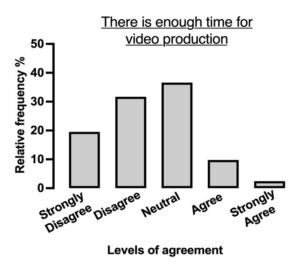
Figure 1. Time as a barrier to making education videos for courses. The responses for each statement were calculated as relative percentage frequencies and represented in a bar chart. The percentages on the vertical axis indicate the proportion of each response compared to the total responses analysed.
.
Faculty members cite their lack of pedagogical knowledge in using educational video appropriately in their courses
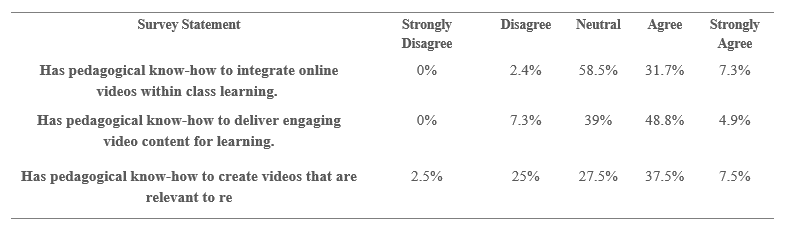
For instructors to use educational videos effectively in their courses, they need to be able to integrate videos into the course rather than treat them as optional add-ons (Brame, 2017). Our survey results showed that more than 60% of our respondents indicated they are not well equipped to integrate online educational videos with their course effectively (Table 2). In our context of integrating educational videos into online classes, this refers to the instructor’s deep understanding of how and why to use videos to support the students’ learning.
Faculty perceptions of their own pedagogical knowledge. Respondents had to indicate their level of agreement to a series of statements on based on a Likert scale, ranging from “Strongly Agree” to “Strongly Disagree”. A score of 1 is given for “Strongly Disagree”, 2 for “Disagree”, 3 for “Neutral”, 4 for “Agree” and 5 for “Strongly Agree.”
.
The majority of our respondents indicate that they do not know how to “position” their educational videos within their courses so that students view them as part of the learning material. Based on their own experiences, students often do not complete the video content before the lesson and tend to dismiss it as optional material rather than essential to their learning, suggesting that learners do not view educational videos as part of the course’s instructional strategy.
In conclusion, our analysis identified key barriers faculty face when integrating educational videos: authenticity, blending online and face-to-face learning, and time constraints. Some barriers found in our study align with existing literature. Based on the identified barriers, we recommend developing resources to address the challenges of blending learning modes and managing time constraints.
Recommendations
Mitigating time constraints experienced by faculty
In line with the literature (Ocak, 2011; Brownell & Tanner, 2012; Zhu, 2008; Brame, 2017), our study has also identified insufficient time to develop and produce educational videos in their courses as one of the significant barriers preventing faculty from utilising educational videos as a learning tool. One effective way to alleviate the faculty workload and free up time for them to produce educational videos is to collaborate with a student assistant (Figure 2). This collaboration can take the form of an undergraduate teaching opportunity programme, where students interested in pursuing a career in teaching can assist faculty in producing educational videos. In this type of collaboration, faculty will supervise students in creating educational videos that align with the learning objectives and materials required by the course. The student assistant can carry out the storyboarding, video production, and editing process.
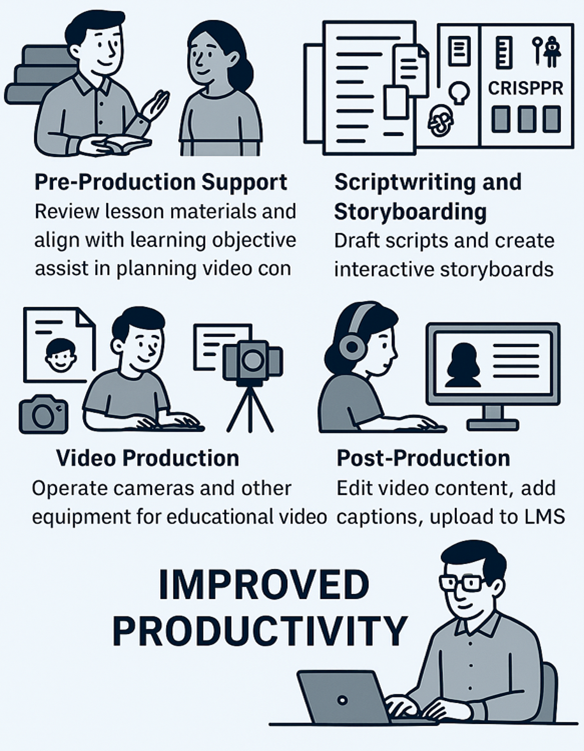
Figure 2. Infographic showing how faculty members can leverage student assistants to help produce educational videos for their course (Images created by ChatGPT 4o).
.
Another way to help faculty members is to use AI tools in educational video production. Currently, AI tools can assist users in generating ideas, scripts, and even storyboards, significantly cutting down the time needed for faculty to create educational videos and enhancing their overall productivity. Additionally, the AI text-to-speech feature allows faculty to transform their existing PowerPoint materials into recorded educational videos for their courses. Utilising these tools boosts the productivity of faculty members.
Development of faculty-wide resources to help in the production of effective educational videos
To enhance faculty knowledge in pedagogical design, educators should focus on three key elements of educational video: (1) managing cognitive load, (2) increasing student engagement, and (3) incorporating active learning (9). Videos can be segmented to aid cognitive load and include interactive questions for better retention. However, those lacking video production experience may find these strategies difficult. We recommend creating a faculty resource page that showcases how seasoned faculty successfully implement these strategies using a “Show, Tell, and Demonstrate” approach.

Figure 3. Infographic showing how faculty members can leverage student assistants to help produce educational videos for their course (Images created by ChatGPT 4o).
.
- Invite a seasoned faculty member to provide insights into their lesson planning process. For new faculty, understanding the thoughtful approach to material coverage within lesson design is crucial to achieving learning objectives. Moreover, grasping how storyboarding is utilised to deconstruct material for educational videos can be beneficial for less experienced faculty.
- Utilising a model educational video, the experienced faculty member will annotate the video to illustrate where pedagogical tools have been integrated to enhance student learning. For instance, they might employ signaling techniques- like altering text color or bolding- to emphasise key information in the videos or accompanying texts, thereby aligning the videos with the overall course design.
- The faculty members will also elucidate their pedagogical strategies and rationalise how these enhance student comprehension of the video content. This involves explaining how the educational video relates to learning objectives and how its placement in the course framework helps establish foundational concepts or enrich understanding following in-class interactions.
- To showcase effective integration, faculty members will share insights and justifications on how the online component (video) supports in-class activities. For example, how can students apply the main learning takeaways from the online segment to their in-class tasks?
By lowering these barriers, universities can empower faculty to adopt educational videos and enhance student learning.
References
Boté-Vericad, J.-J. (2021). Perceived barriers for distance teaching in higher education during the COVID-19 crisis: “I never did a video before”. Education for Information, 37(3), 377-397. https://doi.org/10.3233/EFI-200418
Brame, C. J. (2017). Effective educational videos: Principles and guidelines for maximizing student learning from video content. CBE—Life Sciences Education, 15(4). https://doi.org/10.1187/cbe.16-03-0125
Brownell, S. E., & Tanner, K. D. (2012). Barriers to faculty pedagogical change: Lack of training, time, incentives, and… tensions with professional identity? CBE—Life Sciences Education, 11(4), 339-346. https://doi.org/10.1187/cbe.12-09-0163
Fisher, R., Perényi, A.. & Birdthistle, N. (2021). The positive relationship between flipped and blended learning and student engagement, performance and satisfaction. Active Learning in Higher Education, 22(2), 97-113. https://doi.org/10.1177/1469787418801702
Kintu, M. J., Zhu, C., & Kagambe, E. (2017). Blended learning effectiveness: the relationship between student characteristics, design features and outcomes. International Journal of Educational Technology in Higher Education, 14, 1-20. https://doi.org/10.1186/s41239-017-0043-4
Ocak, M. A. (2011). Why are faculty members not teaching blended courses? Insights from faculty members. Computers & Education, 56(3), 689-699. https://doi.org/10.1016/j.compedu.2010.10.011
Porter, W. W., & Graham, C. R. (2016). Institutional drivers and barriers to faculty adoption of blended learning in higher education. British Journal of Educational Technology, 47(4), 748-762. https://doi.org/10.1111/bjet.12269
Sahni, J. (2019). Does blended learning enhance student engagement? Evidence from higher education. Journal of E-learning and Higher Education, 2019, 1-14. https://dx.doi.org/10.5171/2019.121518
Zhu, E. (2008). 20 Breaking down barriers to the use of technology for teaching in higher education. To Improve the Academy: A Journal of Academic Development, 26(1). https://doi.org/10.1002/j.2334-4822.2008.tb00516.x