KUANG Sze Chiang, Kevin1,2,* and KOH Choon Fah2
1Department of Civil and Environmental Engineering, College of Design and Engineering (CDE), National University of Singapore (NUS)
2NUS Cities, CDE, NUS
Sub-Theme
Building Learning Relationships
Keywords
Relational pedagogy, teamwork, digital collaboration, industry partnership, smart cities
Category
Paper Presentation
Background
Relational pedagogy intentionally builds trust and openness by sharing authority between instructors and students and prioritising reciprocal feedback (Cook‐Sather & Felten, 2014; Su & Wood, 2023; Noddings, 2012). Learning thrives on connections—peer, facilitators, and industry experts. In this course CDE3504 “Smart Cities” shows how gamified workshops, online collaboration, real-world studio projects, industry seminars, and academic–industry co-teaching build relational connections. Regular feedback further deepens these connections and strengthens student learning.
Classroom Practice
Relational pedagogy emphasises that learning develops through interpersonal interaction and shared sense-making (Cook‐Sather & Felten, 2014). Structured peer collaboration and positive interdependence boost motivation and higher-order thinking (Johnson et al., 2007). In our course, students were empowered to co-design their own projects with guidance from staff facilitators and early support from AI tools. Throughout the semester, we introduced a range of teaching methods—outlined below—to reinforce these principles.
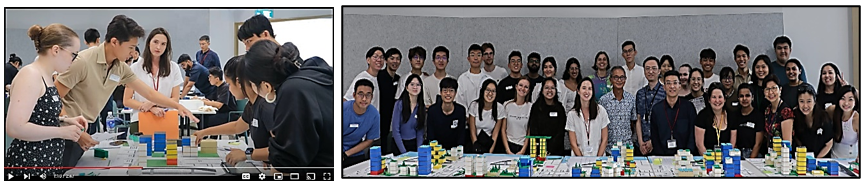
1) UrbanPlan™ Workshop: Developed by the Urban Land Institute (ULI), UrbanPlan™ uses LEGO® blocks in a board-game simulation to immerse teams in urban development (Urban Land Institute, 2023). Facilitated by academic and industry experts, it structures peer negotiation to foster social learning, relational pedagogy, and a shared sense of purpose. Following the NUS Cities-ULI partnership, CDE3504 “Smart Cities” hosted the inaugural UrbanPlan™ workshop in August 2023 (Figure 1).
.
2) Digital Platform Engagement: Use of online collaboration tools such as Padlet and MiroBoard provided transparent peer workspaces where students and instructors exchanged feedback and tracked project progress in real-time (Chu & Kennedy, 2011; Pinto & Leite, 2020). These tools became springboards for ideas, streamlined studio discussions, and fostered connections that extended into WhatsApp and other social channels, strengthening a sense of community.
3) Studio-style classroom supported by blended learning & field trips: Weekly studio sessions combined brief lectures with live critiques. At the mid-semester point, each group received a 800-word written formative feedback—also delivered as AI-generated podcasts—followed by a one-on-one coaching, fostering rich interaction in class. Field trips to Punggol Digital District and the URA City Gallery enabled independent learning and direct dialogue with engineers and planners.
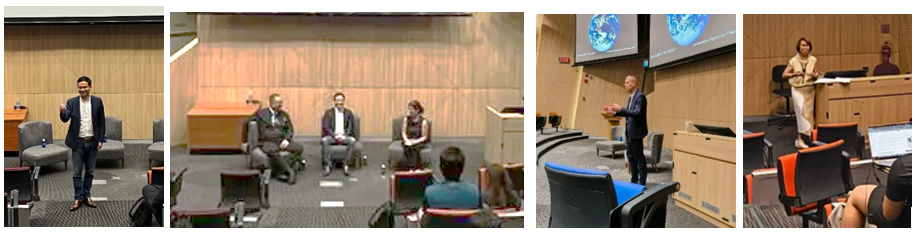
4) Invited industry leader for guest lectures with fire-side chats: CDE3504 hosts fireside-chat seminars with global leaders—CEOs, commissioners, and senior practitioners—providing strategic Smart City insights and blending academic and industry expertise to build networks, boost engagement, and empower students (Bringle & Hatcher, 2002) (Figure 2).
.
Assessment Methods
We used a mixed-methods approach. Quantitative survey data (Likert-scale ratings and outcome scores) were analysed descriptively and compared across cohorts to track changes. Qualitative evidence from reflections, focus groups, and digital artifacts was thematically coded by tagging recurring ideas and clustering them into broader themes such as trust, peer collaboration, and feedback. Triangulating these sources enhanced rigor and strengthened confidence in the findings.
Data sources included:
- Surveys: Mid-semester and end-of-course ratings and qualitative feedback from students
- Feedback: Focus groups explored MiroBoard/Padlet usage, peer trust, and workshop reflections.
- Artifact Analysis: Review of digital artifacts—Miro boards, Padlet posts, and reflection journals—for evidence of co-creation, peer-to-peer and student–instructor interactions, and the evolution of group dynamics.
Summary Observations
The UrbanPlan™ workshop fostered positive interdependence: Under time pressure, student teams collaboratively negotiated real estate proposals to reach consensus, building mutual trust and ensuring balanced participation. Surveys also revealed that students highly valued the facilitation by industry experts, with most rating those sessions as “Strongly” or “Very Strongly” valuable.
Digital platforms: The online tools allow students to post ideas asynchronously individually or following discussion in a group. Many reported that reading peers’ posts and ideas first made them more confident to contribute to the conversation or process. This extended relationship-building beyond scheduled class time. We saw clear evidence of students building on each other’s ideas, asking questions, and refining proposals together.
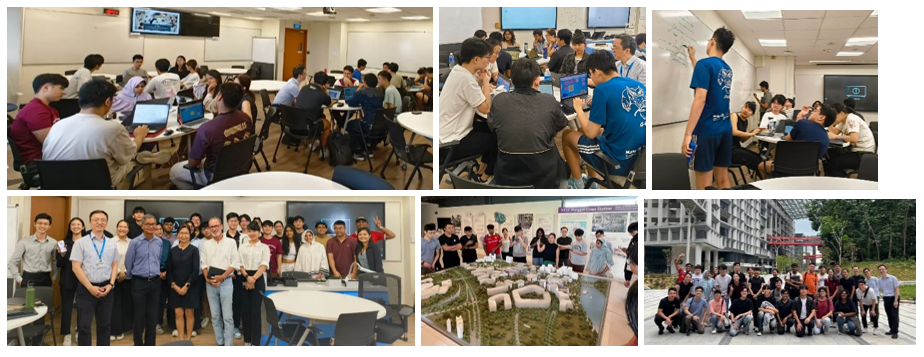
Studio-style classroom supported by blended learning & field trips (Figure 3). Students consistently reported feeling supported and valued, highlighting that regular check-ins and personalised feedback underscored instructors’ genuine care for their progress. This nurturing environment enabled them to refine their work with confidence, deepened engagement during field trips, and fostered professional growth. Qualitative reflections assignments by students suggest that relational pedagogy transformed their initial self-doubt into active participation through weekly studio critiques and targeted feedback.
.
Meanwhile, quantitative gains—from an outcome achievement rating of 8.2/10 in AY2023 to 9.0/10 in AY2024—demonstrate the effectiveness of iterative relational strategies, with improvements in feedback provision to students. Interviews and artifact analysis further reveal enhanced critical thinking, strengthened collaborative skills, and the emergence of professional confidence among students.
.
References
Bringle, R. G., & Hatcher, J. A. (2002). Campus–community partnerships: The terms of engagement. Journal of Social Issues, 58(3), 503-516. https://doi.org/10.1111/1540-4560.00273
Chu, S.-W., & Kennedy, D. M. (2011). Using online collaborative tools for groups to co-construct knowledge. Online Information Review, 35(4), 581–597. https://doi.org/10.1108/14684521111161945
Cook-Sather, A., Bovill, C., & Felten, P. (2014). Engaging students as partners in learning and teaching: A guide for faculty. John Wiley & Sons.
Johnson, D. W., Johnson, R. T., & Smith, K. A. (2007). The state of cooperative learning in postsecondary and professional settings. Educational Psychology Review, 19(1), 15–29. https://doi.org/10.1007/s10648-006-9038-8
Noddings, N. (2012). The caring relation in teaching. Oxford Review of Education, 38(6), 771–781. https://doi.org/10.1080/03054985.2012.745047
Pinto, M., & Leite, C. (2020). Digital technologies in support of students learning in Higher Education: literature review. Digital Education Review, (37), 343-360. https://doi.org/10.1344/der.2020.37.343-360
Su, F., & Wood, M. (2023). Relational pedagogy in higher education: What might it look like in practice and how do we develop it? International Journal for Academic Development, 28(2), 230–233. https://doi.org/10.1080/1360144X.2023.2164859
Urban Land Institute. (2023). UrbanPlan™ program overview. https://asia.uli.org/programs/urbanplan/