
Sub-Theme
Building Technological and Community Relationships
Keywords
Data storytelling, Generative AIs, adult learners, lifelong learning, custom GPTs
Category
Paper Presentation
Introduction
The concept of lifelong learning has gained renewed importance in the digital age. In a digital economy where technology-driven disruptions continuously reshape industries, knowledge and skills acquired in formal education quickly become outdated. To address these challenges, lifelong learning has emerged as a necessity, requiring individuals to continuously reskill and upskill throughout their careers (Lim et al., 2024).
Among the competencies gaining recognition is data storytelling, the ability to communicate insights from data through compelling and human centered narratives. Over the past decade, industry experts have underscored the strategic importance of storytelling (Davenport, 2015; Dykes, 2020; Knaflic, 2015). Data storytelling serves as a bridge between facts and decision-making, enhancing comprehension, engagement, and persuasion.
Generative AI technologies will transform how individuals interact with data, lowering technical barriers and enabling greater emphasis on creativity and narrative construction (Dykes, 2024). For adult learners, Generative AI has opened new possibilities for personalized, self-directed learning, supporting the broader agenda of lifelong learning. Despite its potential benefits, adult learning environments remain underexplored in AI-driven educational transformation. Research by Adarkwah (2024) highlights how adult learners apply GenAI technologies to achieve their educational and professional goals remains unclear.
The Community of Practice (CoP) model (Wenger, 1998) offers a suitable framework for fostering social, participatory, and knowledge-creating experiences in navigating through Generative AI and interdisciplinary competencies like data storytelling.
Our presentation explores the integration of NarratEve, a custom GPT learning companion, into a CoP session designed to enhance data storytelling competencies. NarratEve was first introduced during a Lightning Talk (“Reimagining Data Storytelling with Generative AI”) at NUS HECS 2024 (Ang, 2024). In this paper, we present the findings from the NUS Data Literacy Programme (DLP) Community of Practice held in May 2025, titled “Reimagining Data Storytelling with Generative AI”), supported by the NUS Office of Human Resources (OHR).
Methods
Learners who completed basic DLP and/or one intermediate DLP module were invited to sign up. There was a total of 61 adult learners. Conducted in-person, the session was structured as an active learning experience, combining practical application of data storytelling principles with storytelling group activities supported by NarratEve and presentations to foster shared learning and reflective dialogue.
Results
Fifty (82%) participants completed the survey conducted by OHR. The feedback reflected a high level of satisfaction (“Agreed” or “Strongly Agreed”) and perceived impact of the session across multiple dimensions. 96% reported increased confidence in using NarratEve for data storytelling, and 84% felt confident transforming analysis into compelling narratives. 98% agreed that the session objectives were met and the activities enhanced understanding. Materials were found to be clear and useful by 96%, while 92% affirmed relevance to their work. 94% found the duration appropriate. Notably, 100% of respondents expressed overall satisfaction and would recommend future DLP CoP sessions.
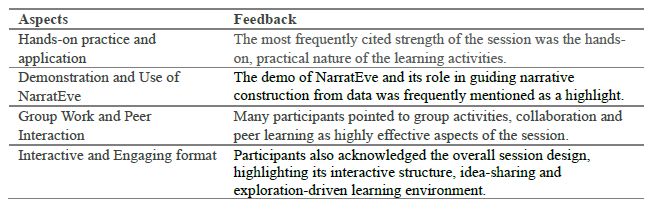
Qualitative feedback on the most effective aspects
.
Conclusion
The findings from our study suggest the potential value of integrating a custom GPT within social learning environments to support data storytelling skill development. The Community of Practice emerged as a promising pedagogical approach, offering adult learners opportunities to co-construct knowledge and engage in active exploration. As industries and workplaces continue to evolve, lifelong learning must be reimagined not only through what is learned but how learning happens.
References
Adarkwah, M. A. (2024). GenAI-infused adult learning in the digital era: A conceptual framework for higher education. Adult Learning, 0(0). https://doi.org/10.1177/10451595241271161
Ang, E. (2024). Reimagining data storytelling with generative AI [Lightning talk]. In Higher Education Conference in Singapore (HECS) 2024, 3 December, National University of Singapore. https://blog.nus.edu.sg/hecs/hecs2024-eang/
Davenport, T.H. (2015) Why data storytelling is so important-and why we’re so bad at it. https://www2.deloitte.com/us/en/insights/topics/analytics/data-driven-storytelling.html
Dykes, B. (2020). Effective data storytelling: How to drive change with data, narrative, and visuals. John Wiley & Sons, Inc.
Dykes, B. (2024). The Future of Data Storytelling is Augmented, not Automated. Forbes. https://www.forbes.com/sites/brentdykes/2024/02/27/the-future-of-data-storytelling-is-augmented-not-automated
Knaflic, C. N. (2015). Storytelling with data: A data visualization guide for business professionals. Wiley.
Lim, Z. Y., Yap, J. H., Lai, J. W., Mokhtar, I. A., Yeo, D. J., & Cheong, K. H. (2024). Advancing lifelong learning in the digital age: A narrative review of Singapore’s SkillsFuture programme. Social Sciences, 13(73). https://doi.org/10.3390/socsci13020073
Wenger, E. (1998). Communities of Practice: Learning, meaning, and identity. Cambridge University Press.