

Sub-Theme
Building Learning Relationships
Keywords
Authentic problem solving, workplace application, CET, collaboration
Category
Lightning Talks
This lightning talk introduces an effective learning approach—“Active Learning for Problem Solving” (ALPS), implemented by NUS-ISS for professional learners in CET (continuing education and training) sector. The ALPS approach anchors on problem solving of authentic workplace problems faced by organisations, leveraging the power of team collaboration in learning and application. Instead of the ‘just-in-case’ learning format where learners pick up skills from courses, (just in case they need it later), ALPS approach emphasises ‘just-in-time’ learning where learning and application to real-life workplace problems happen simultaneously.
An example is the “Digital Service Management Programme” (DSMP) which was successfully conducted for 10 teams across various government agencies in 2023 to 2024. In 2025, another three runs are currently being implemented and would be completed by end 2025. The programme has been developed with the intent of supporting organisations who are interested in investing in their employees but would also like to see business outcomes where employees can demonstrate application of learning to the workplace. Employees, being adult learners are motivated by a sense of purpose (Cox, 2005) and their own agency to make a difference in their own job roles and careers.
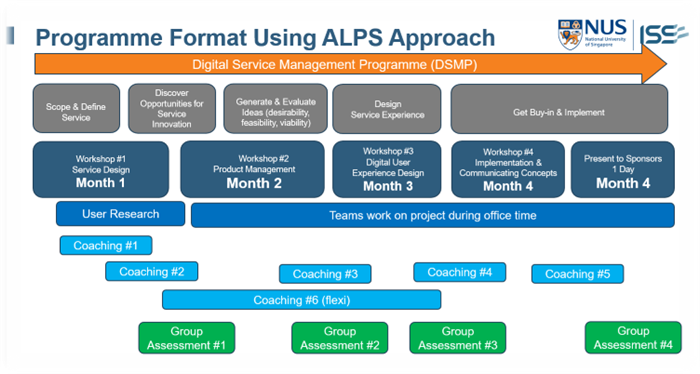
The programme consists of four workshops of eight days, and six half-day coaching sessions across a 4-month period. Learners enrol themselves as an intact team, with an organisational problem area identified with a project sponsor. This ensures accountability and also provides validation that the problem is worth solving and valuable to the organisation. An overview of the programme is shared in Figure 1.
.
Lecturers and Learners Relationship
The relationship between lecturers and learners is that of business partners working together towards the common goal of solving the organisational problem on hand. Unlike traditional classroom teaching, learners are put in the driver seat to drive their own learning, while project sponsors keep the learners accountable for the progress. Lecturers play roles of teacher, facilitator, mentor and coach in the process. This approach combines experiences in workplace with experiences in education to help working adults meaningfully navigate worklife learning effectively (Choy & Le, 2023).
Contrary to the belief that planned curriculum, enacted curriculum and experienced curriculum needs to be aligned, this programme is designed intentionally to allow flexibility in the enacted curriculum to suit the needs of different groups (Grundén, 2022). Due to the differences in the nature of the programme, each of the coaching session is customised for the teams based on their level of knowledge and status of the project. The teams will initiate and drive the conversations, where lecturers play the role of a ‘sounding board’ to highlight any blind spots or to help teams deepen their application of the concepts learnt. As such, the enacted curriculum and experienced curriculum will differ individual to individual based on their prior knowledge and expertise areas.
One limitation of this approach is that lecturers themselves need to be highly competent in the related and adjacent domain areas as they need to coach and advise learners on the spot. It takes more effort and time, as they need to build their capabilities through ‘Reflection in Action’ and ‘Reflection on Action’ (Munby, 1989; Schon, 1983).
Learners and Learners Relationship
The relationship between learners is also interesting. Even though the learners may come as a team from the same organisation, they may or may not have the time and space to work together. Indeed, some of the findings we hear from learners are “we have not worked together like this before”, and “we get real work done” during the programme, providing ‘protected time’ for them to focus and apply what they learn. Another form of learning is peer learning across groups. Even though each group has their own problem areas to work on, there are multiple opportunities for cross-learning across government agencies. Lecturers consciously design the curriculum and environment for interaction, allowing learners to tap on one another’s experiences and ideas.
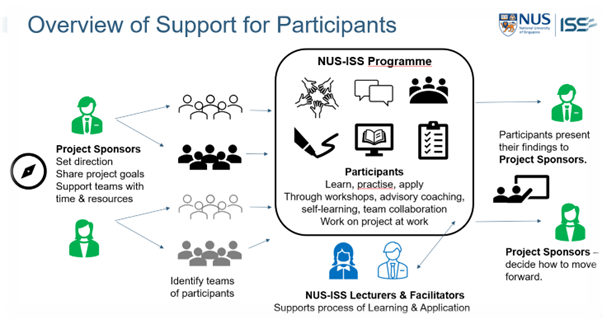
At the end of the programme, a Gallery Walk approach is used where each team showcases their discovery journey, learning and recommended solutions to their sponsors and stakeholders across agencies. Lecturers also designed a feedback mechanism where any of the invited guests can write comments and questions on post-it and paste it on the teams’ artefacts. This again provides cross-agency feedback and learning, which is both inspiring and highly motivating for the teams. Throughout the learning journey, learners are well supported (see Figure 2) and a high level of learning and application is achieved.
..
References
Choy, S., & Le, A. H. (2023). Workplace practices that support learning across working life. Australian Journal of Adult Learning, 63(3), 320–342. https://search.informit.org/doi/10.3316/informit.473750573457177
Cox, E. (2005). Adult learners learning from experience: using a reflective practice model to support work‐based learning. Reflective Practice, 6(4), 459–472. https://doi.org/10.1080/14623940500300517
Grundén, H. (2022). The planned curriculum—Not just a matter of teachers. The Curriculum Journal, 33, 263–278. https://doi.org/10.1002/curj.151
Munby, H. (1989). Reflection-in-Action and Reflection-on-Action, Education and Culture: Vol. 09 : Iss. 1, Article 4. https://docs.lib.purdue.edu/eandc/vol09/iss1/art4
Schon, D. A. (1983). The reflective practitioner: How professionals think in action. Basic Books.