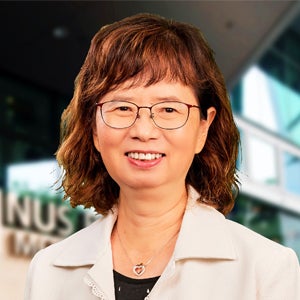
CHIAN Siau Chen
Department of Civil and Environmental Engineering, College of Design and Engineering (CDE), National University of Singapore (NUS)
Sub-Theme
Building Learning Relationships
Keywords
Authentic learning, collaborative design, engineering economics, innovative thinking
Category
Lightning Talks
In the pursuit of developing engineers who are both technically proficient and economically astute, a third-year geotechnical engineering course introduces an open-ended group project. This initiative encourages students to propose innovative geotechnical design and construction methodologies, evaluate their feasibility, and assess the total construction cost. By challenging conventional methods and fostering resourcefulness, students are encouraged to overcome constraints outlined in the project brief.
This approach not only enhances technical knowledge but also emphasizes the importance of collaboration and relationship-building in the learning process. By integrating real-world problems into the curriculum, students engage in authentic learning experiences that promote exploration, discussion, and the meaningful construction of concepts and relationships relevant to the course.
Background
In an evolving engineering landscape where solutions must be both technically sound and economically viable, the cultivation of adaptive, resourceful, and innovative engineers (“thinking engineers”) is of paramount importance. To address this educational need, a transformative pedagogical initiative rooted in authentic learning and problem-based learning (PBL) was introduced within the third-year geotechnical foundation engineering module, a core course in the civil engineering undergraduate degree curriculum.
The centerpiece of this initiative is an open-ended, group-based design project that simulates a real-world engineering scenario: the conceptual and technical design of a deep foundation system for a high-rise residential structure. This project invites students to integrate geotechnical knowledge with economic reasoning, challenging them to produce technically sound and cost-effective solutions under realistic site and resource constraints. In doing so, the project aligns with constructivist pedagogy, allowing students to actively build on their theoretical knowledge in a practical, applied context.
Methodology
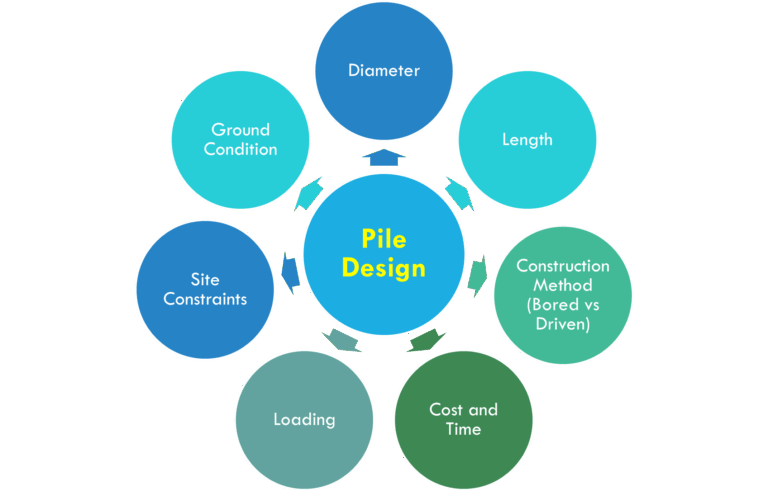
The novelty of the initiative lies in its emphasis on experiential learning and design thinking. Students are required to evaluate both geotechnical and structural pile capacities using borehole data and structural load information. They must consider multiple interrelated factors such as pile diameter and length, construction method (bored vs. driven), material costs, and site constraints, by engaging in iterative analysis and trade-off decision-making that mirrors the design optimization process in professional practice (Figure 1).
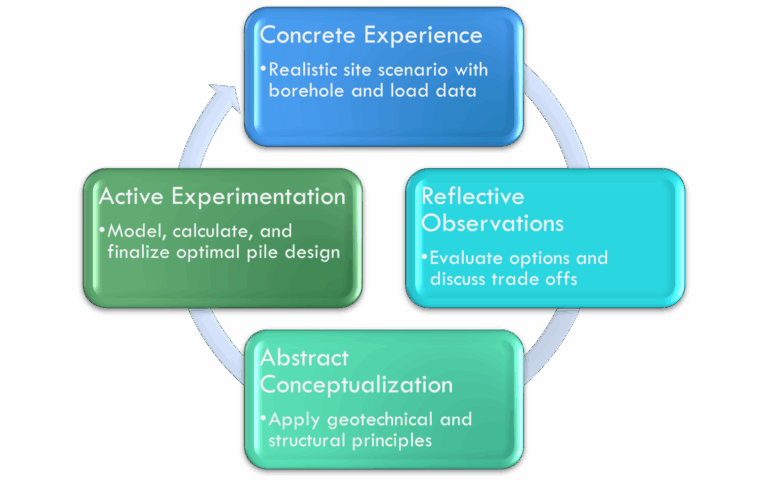
This structure supports inquiry-based learning, as students explore various foundation options, test hypotheses through calculation and modeling, and justify their final designs with technical and economic evidence. The iterative process reflects Kolb’s experiential learning cycle (1984), as students cycle through concrete experience, reflection, abstraction, and active experimentation (Figure 2).
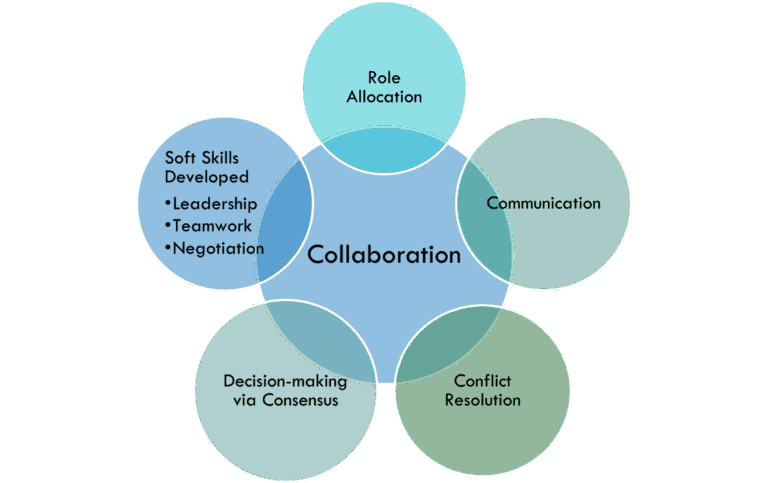
Collaboration is central to the project. By working in teams, students engage in collaborative learning, developing crucial soft skills such as communication, leadership, conflict resolution, and consensus-building (Figure 3). These team dynamics simulate real-world engineering workflows, reinforcing the interpersonal competencies demanded by industry.
.
.
.
Additionally, scaffolding is employed in the initial project stages, providing students with structured guidance on design principles, costing techniques, and analysis tools. As students gain confidence and capability, this support is progressively withdrawn to promote independence and self-directed learning.
Outcome
The outcomes of this pedagogical initiative go well beyond academic assessment. Through sustained engagement with complex, context-rich problems, students develop not only a stronger command of geotechnical principles but also a keen awareness of economic and logistical constraints, demonstrating a hallmark of authentic learning. They emerge better equipped for contemporary civil engineering practice, with sharpened skills in critical thinking, decision-making under uncertainty, and interdisciplinary integration (blending geotechnics, structures, construction methods, and cost analysis).
Furthermore, the incorporation of peer review and reflective discussion sessions nurtures reflective practice, encouraging students to evaluate their design process, challenge assumptions, and learn from both success and failure. This reflection deepens learning and fosters the mindset of lifelong improvement: a key attribute of professional engineers.
Feedback
Student feedback has been overwhelmingly positive, citing increased engagement, practical relevance, and a deeper understanding of how theory is applied in real-world scenarios. Many expressed that this was the first time they truly “felt like engineers”.
Conclusion and Future Directions
This initiative demonstrates how the strategic integration of progressive pedagogies: authentic learning, PBL, inquiry-based learning, collaboration, and experiential learning, can cultivate the “thinking engineer” ethos. Looking forward, future iterations of the project may incorporate dimensions such as environmental sustainability and life-cycle analysis to further enhance the interdisciplinary and systems-thinking elements of the task.
By embedding pedagogical best practices into curriculum design, engineering educators can bridge the gap between academia and industry, empowering graduates to not only solve problems but to redefine them with creativity, responsibility, and rigour.
Reference
Kolb, D. A. (1984). Experiential learning: Experience as the source of learning and development. Prentice-Hall.