Nurulhuda Mustafa, and Gavin DAWE
Department of Pharmacology, Yong Loo Lin School of Medicine (YLLSOM), National University of Singapore (NUS)
Sub-Theme
Building Technological and Community Relationships
Keywords
Industry engaged curriculum, MSc programme, life sciences, relational curricula
Category
Lightning Talk
As we prepared to launch the MSc in Medical Pharmacology at NUS, we knew that aligning with industry was just the starting point. We wanted to design a curriculum that would help students see themselves as part of the life sciences ecosystem—Can postgraduate curriculum become more than a path to expertise – can it be a bridge that connects learners to real-world communities of practice?
As postgraduate biomedical education evolves, the need to foster meaningful engagement between learners and the broader life science sector has become increasingly urgent. Many programmes still focus narrowly on knowledge transmission or technical competence overlooking curricula design strategies that can build symbiotic relationships between students and the professional ecosystem.
Here we will share some insights from the development of the MSc in Medical Pharmacology programme at NUS – a programme purposefully structured to serve as a relational bridge between postgraduate learners and the biomedical innovation community. This model aligns with current research emphasising relational knowledge exchange which values sustained collaboration, trust and respect across higher education and industry partnerships, moving beyond transactional skill transfer to create meaningful and embedded connections (Dismore et al. 2024)
Anchored in the insights from SGInnovate’s report “Bridging the Talent Gaps in Singapore’s Biotech Sector” (SGInnovate, 2022), the MSc curriculum was co-developed through iterative consultation with over 10 local and international stakeholders across biotechnology, regulatory science, academic and clinical pharmacology. Insights were gathered through industry panel sense-making sessions and targeted one-on-one consultations conducted both in-person and via Zoom. The feedback provided actively shaped the curriculum and was incorporated to refine the programme’s focus areas, curate topics of greatest industry relevance and to embed professional skills aligned with workforce expectations. Importantly, involving industry partners upstream also enabled us to tap into their networks, securing expert speakers to deliver practice-oriented content.
Grounded in relationships established through deep consultation during early curriculum development, industry experts were subsequently engaged not merely as guest lecturers but as invested co-creators contributing to course design, learning activities and modes of assessment. At the culmination of this collaboration, industry experts can choose to co-supervise the programme’s capstone projects alongside academic mentors—guiding students through real-world problem solving in authentic scenarios transforming the capstone into a professional rehearsal. This integrative experience at the end of the programme reflects the programme’s commitment to embed relational learning that bridges our learners with the life science community and ecosystem.
The course PHM5013 “Precision Drug Discovery and Development” was developed as a pilot course to trial this approach. It was structured around key industry workflows, including target validation, clinical development and biomarker design paired with case discussions and learning activities that invite students to adopt professional roles.
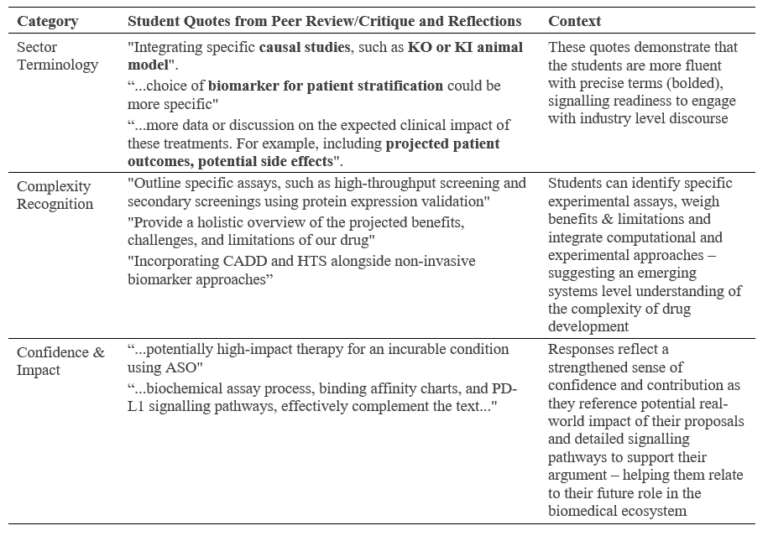
Though the MSc programme is not fully launched yet student responses from this proof-of-concept pilot course demonstrates the value of this approach—students speak and act with more clarity and conviction, and started connecting the dots between scientific knowledge, regulatory realities, and patient impact. This was observed over a series of scaffolded assignments. Reflections and artefacts demonstrate increase fluency in sector terminologies, recognition of complex environments in which the learner will operate in in future and confidence in articulating real-world contributions (Table 1).
Students’ quotes from peer review/critique and reflections
.
In most postgraduate programmes, industry engagement is often treated as a downstream addition to the curriculum. In contrast, we propose that the curriculum itself can serve as a relational bridge – intentionally designed to meaningfully engage and embed industry throughout the learning journey. Through this integrated approach, it becomes a conduit that connects students not only to sectoral knowledge but to communities of practice, and a clearer sense of the roles they can grow into within the life science ecosystem.
.
References
Dismore, H., Campbell-Barr, V., Manning, R., & Warwick, P. (2024). A relational approach to knowledge exchange in higher education. Studies in Higher Education, 49(12), 2534–2545. https://doi.org/10.1080/03075079.2024.2312404
SGInnovate (2022, December 16). Bridging the Talent Gaps in Singapore’s Biotech Sector. https://www.sginnovate.com/blog/bridging-talent-gaps-singapore-biotech-sector