Losheini Ravindran
Office of the Provost (PVO), National University of Singapore (NUS)
Sub-Theme
Building Learning Relationships
Keywords
REx programme, undergraduate research, collaborative learning, inquiry, student voice
Category
Lightning Talks
At the heart of meaningful education lies the ability to build strong, dynamic relationships—between students and educators, institutions and learners, and knowledge and application. This approach is reinstated in undergraduate research where a valuable relationship can be built between students and educators through a community of inquiry. In Govender and Pillay’s article on Undergraduate Research (Govender & Pillay, 2022), it is however noted that undergraduate students tend to have limited exposure to research knowledge and skills and that this may pose challenges when entering work life or graduate studies.
To address this gap, the Undergraduate Research (UGR) Team at the Office of the Provost (PVO) has been fostering deeper connections between students and educators through research participation. Programmes such as the Undergraduate Research Opportunities Programme (UROP) and the Research Experience (REx) initiative serve not only as platforms for inquiry but as bridges linking students to mentorship, skills development, and career discovery.
In an article on mentored undergraduate research, it is mentioned of how academic developers can help faculty understand that a core part of the mentoring relationship is supporting the students’ own identity development as they do not necessarily belong to one particular faculty and as such have the cognisance of the different types of practices adopted by various faculties hence placing them in a unique position (Larson et al., 2018). The UGR team deeply resonates with the above and has made conscientious efforts in encouraging students to approach their learning holistically with research experience as a vehicle that motivates them to navigate their future paths in higher education and beyond.
To strengthen these educational relationships, PVO collaborated with the NUS Centre for Future Ready Graduates (CFG) in 2024 to conduct a university-wide survey exploring students’ views on research participation and its relevance to career preparation. A total of 927 undergraduates responded, representing a cross-section of disciplines and academic years. As such, this paper takes the stance that the student voice is central to understanding through their own words and rankings, how students perceive research and its value in their educational journeys and subsequently in their career decisions.
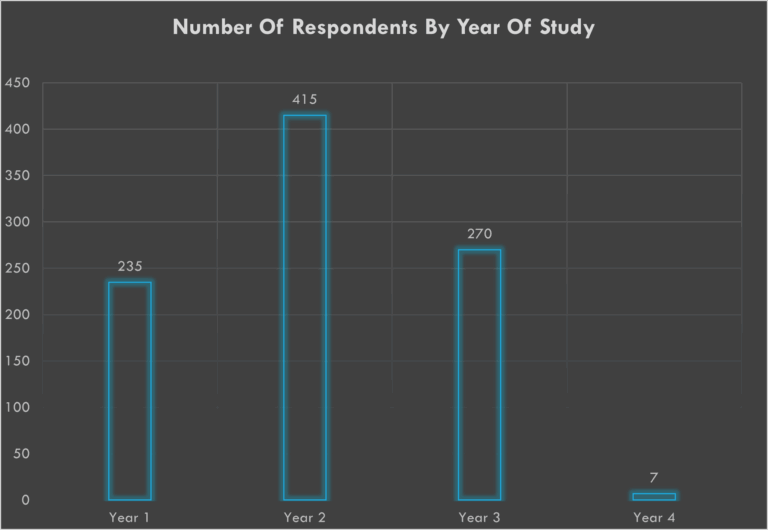
A significant proportion (45%) of respondents were Year 2 students (Figure 1A), making them a key target group as they typically begin engaging in research opportunities during this phase. While responses from final-year students were minimal, the timing was ideal to shape second-year students’ academic pathways through meaningful research-based interventions and mentoring.
.
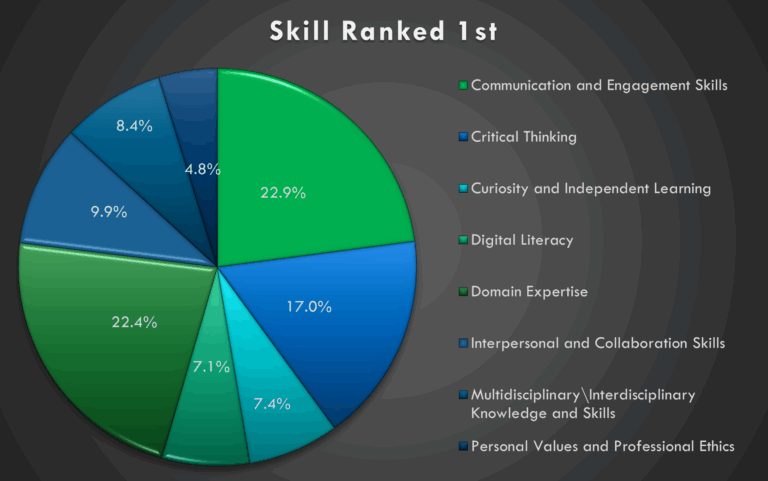
A key insight emerged from the question: “To what extent do you agree that research is relevant to your major?” Students were asked to rank the skills they associated with research relevance. Figures 1B, 1C, and 1D present the distribution of skills ranked 1st, 2nd, and 3rd respectively by the same group of survey respondents. In the survey, participants were asked to prioritize skills by assigning a first, second, and third rank. Figure 1B therefore shows which skill respondents considered most important (Rank 1), Figure 1C reflects their secondary priorities (Rank 2), and Figure 1D illustrates the tertiary choices (Rank 3). Together, these figures capture not only the top skill valued by students but also how their preferences shift when considering subsequent ranks.
(Note: A skill that has already been identified as having most votes in the preceding rank will not be considered for subsequent ranks)
.
From the first-rank responses (Figure 1B), students prioritised Communication and Engagement Skills (22.9%) and Domain Expertise (22.4%) above other competencies.
.
.
When asked for their second-ranked skills (Figure 1C), Critical Thinking (23%) and Interpersonal and Collaboration Skills (21%) emerged strongly, while the third-ranked responses (Figure 1D) highlighted Multidisciplinary/Interdisciplinary Knowledge (26%) as an important tertiary consideration. Taken together, these findings suggest that while students value subject-specific expertise and communication skills most immediately, they also recognise the importance of critical thinking, collaboration, and interdisciplinary perspectives when ranking beyond their top choice. This layered preference provides evidence that future research programmes should not only emphasise depth in domain knowledge but also be designed to integrate opportunities to build communication, critical thinking, and collaborative competencies in a multidisciplinary setting.
These priorities cut across disciplines, reaffirming that students see research not only as an academic pursuit but as a context where transferable, career-relevant skills are cultivated. More importantly, they signal the kinds of skills students wish to develop: the ability to express ideas clearly, work thoughtfully with others, and engage critically with knowledge.
These findings strongly align with the design of the REx Programme, which features curated workshops such as “Research Communication and Ethics in Research”. These sessions nurture students’ ability to communicate with conviction, think ethically and analytically, and collaborate across diverse disciplines. More than skill-building, such initiatives serve as relationship-building platforms by connecting students with mentors, peers, and real-world applications.
.
However, the data also uncovered a paradox. As shown in Figure 1E, while 30% of students indicated they saw few career opportunities in their major, many of them were still able to name a wide range of possible roles. Two patterns emerged as a result:
- Students are overwhelmed by the breadth of options, struggling to identify a specific direction.
- Students, especially in academic (non-professional) programmes, view research as a fallback rather than an empowered choice—due in part to a lack of contextual guidance.
The same uncertainty is reflected in the ranking of skills (Figures 1B–1D). Students consistently placed tangible, immediate competencies—such as Communication and Engagement Skills (22.9%) and Domain Expertise (22.4%)—as their first priorities. By contrast, broader integrative skills, such as Multidisciplinary/Interdisciplinary Knowledge (26% in Rank 3) and Ethics (10% in Rank 3), were relegated to lower ranks. This layered distribution suggests that although students recognise a wide spectrum of opportunities and skills, they may struggle to connect these broader competencies with clear career pathways.
This dissonance points to a relational gap—not between students and opportunity, but between students and their ability to see and navigate those opportunities. Their uncertainty indicates a need for deeper, more intentional guidance within academic programmes, especially guidance that connects research learning with career ecosystems and life pathways. Ultimately, our findings suggest that teaching and learning relationships must evolve beyond the transmission of knowledge. When students understand how research connects with their goals, and when they feel supported in that discovery, research becomes a transformative, identity-shaping experience. By integrating student voice, skill development, and career relevance, research education can become a relational practice: one that empowers students not just to learn, but to grow with purpose.
References
Centre for Future Ready Graduates. (2024). Survey on undergraduate research experience. Singapore.
Office of the Provost, National University of Singapore. (2024). Survey report: Relevance of undergraduate research for future employment. Singapore.
Matthews, K. E. (2022). Constructing higher education with students as partners in learning and teaching. In H. Coates, X. Gao, F. Guo, & J. Shi (Eds.), Global student engagement (1st ed., Vol. 1, pp. 158–170). Routledge.
Owusu-Agyeman, Y., & Fourie-Malherbe, M. (2019). Students as partners in the promotion of civic engagement in higher education. Studies in Higher Education, 46(6), 1241–1255. https://doi.org/10.1080/03075079.2019.1666263
Larson, S., Partridge, L., Walkington, H., Wuetherick, B., & Moore, J. L. (2018). An international conversation about mentored undergraduate research and inquiry and academic development. International Journal for Academic Development, 23(1), 6–14. https://doi.org/10.1080/1360144X.2018.1415033
Govender, I., & Pillay, R. (2022). Undergraduate inquiry-based research to promote Sustainable Development Goal 11 (Sustainable Cities and Communities). African Journal of Inter-Multidisciplinary Studies (Online), 4(1), 113. https://doi.org/10.51415/ajims.v4i1.1025