
LIN Wenlin, Yvonne, and ONG Pei Pei, Corinne
Ridge View Residential College (RVRC), National University of Singapore (NUS)
Sub-Theme
Building Learning Relationships
Keywords
Mentorship, learning communities, residential college, competence education, holistic development
Category
Lightning Talk
Introduction/Purpose of Study
Worldwide, higher education is shifting towards flexible learning pathways (FLPs) and a focus on competence-based education to meet diverse needs and changes in workforce requirements (International Institute for Educational Planning, 2024). Higher education has since evolved from merely transmitting knowledge, to facilitating active learning and mentorship opportunities that enable 21st century learners to effectively acquire critical competencies for their holistic development.
Studies have examined how mentoring relationships can be developed in higher education. These benefits range from impact of mentoring on learners’ motivation, emotional well-being, psychosocial development, to a sense of community and belonging (Zamiri & Esmaeili, 2024). Yet, few studies have examined how faculty-student mentorship relationships can be actualised in higher education, and the benefits it offers for supporting competence-based learning.
Furthermore, scholars note the dearth of guiding frameworks for conceptualising and justifying mentorship’s value to student learning and development in higher education. In addressing these gaps, Nuis et al. (2023) proposed a framework that specifies the objectives, functions, and forms that mentorship can assume (Figure 1). Similarly, McKinsey (2016) empirically validated three mentorship phases—connection, collaboration, mutual commitment—that characterise mentoring relationships, and its corresponding impacts on learners.
Method
Through a reflection of the authors’ experience with mentorship in a residential college (RC), we apply two of the above frameworks to demonstrate: (1) how an RC can provide prime conditions for fostering mentorship relationships; and (2) the impact of mentorship for achieving the goals of competence-based education.
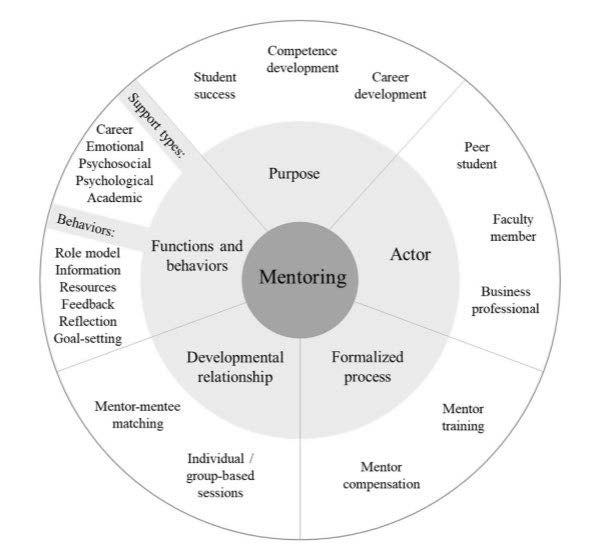
.
Findings
Establishing Connections
The authors’ mentorship with students were initiated following a call by the National Environment Agency (NEA), a non-credit bearing programme: the Youth for Environmental Sustainability (YES) Leaders Programme. Since 2023, the one-year national leadership programme aims to equip youths with the knowledge of sustainability issues, skills to ideate projects by providing opportunities to network with industry experts, and funding to implement successfully proposed projects (NEA YES, 2025).
Two groups of students from a residential college were nominated by the authors. Two of these students were acquainted with the first author through the general education courses she taught in the College. A connection developed as students and faculty interacted in multiple informal residential activities in the College, which facilitated casual conversations on students’ interests in sustainability and the YES programme’s opportunities. Discussions also surrounded how the programme could be propitious for students’ competency development and career prospects, broaching one of the “purposes” of mentorship expounded by Nuis et al. (2023).
Collaborations for Learning
Initially, students brainstormed their own proposal ideas. As students were new to drafting formal grant proposals, we provided guidance through feedback to students on their written drafts, budget proposals, and directed them to relevant information and stakeholders for ideas and project sponsorships.
During project implementation, students learnt the difficulties of outreach to key stakeholders as non-responsive emails from prospective partners derailed early plans. We empathised that students may not have experienced such unexpected situations and inculcated problem-solving skills in them, by encouraging them to be proactive in outreach and devise contingency plans.
Concerning the “functions and behaviours” and “support types” specified in Nuis et la. (2023) framework, the mentorship collaboration promoted mentees’ acquisition of problem-solving skills, goal-setting skills, and new knowledge and networks. Motivational support was also integral to mentees, as exemplified:
“[The mentors] generally provided timely support and guidance for our project. They checked in on the progress of our project from time to time and gave encouraging remarks like “good start” when we submitted the initial drafts of our proposals or reports… Moreover, [the mentors] helped us to spot rare opportunities that could enhance our project… I appreciated that they always listened out to what ideas [my team] wanted to express, before suggesting to us how we could feasibly execute them based on their personal experience.” (S1)
“[Our mentors] took their time during holidays to give us a crash course on Design Thinking. The process of empathizing, prototyping, iterating… they [also] used their personal connections to help us in our project…. The site visit and interaction allowed us to learn from the people that have experienced using something similar to the solution that we have, broadening our perspective to see what potential problem that we might face and how we can improve further.” (S2)
Committing to Mentorship
Throughout the programme, as mentors, we maintained our availability to students through individual and group check-ins, offering continued motivational support. We proposed options on time-management, goal-setting, and problem-solving for students to achieve project delivery. At the same time, we remained mindful that students were responsible for ultimate decisions made, as two mentees expressed:
“While urging us to seize these opportunities, they were also mindful of periods when we were busier with our school assignments and exams and gave us autonomy to make the final decision.” (S1)
“Both [mentors] checked in on us from time to time, which benefits us greatly… They have been great encouragement, being someone who believes that our projects mean something when we cannot see it ourselves and about to give up.” (S2)
.
Conclusion
On reflection, we discovered the importance of referencing conceptual frameworks on mentorship to guide mentorship arrangements and developments. Developing a ‘contract’ with students on what they wish to gain from the mentoring relationship is critical, to manage mutual expectations and create a more accountable mentorship as one mentee recounted being “sometimes lost at what to do first”. With a framework, faculty keen to pursue mentorship roles can be aware of the responsibilities, commitments, and boundaries involved, to engage in forthcoming discussions on roles and needs with mentees. Finally, formal institutional support and recognition of faculty mentors engaged and interested in mentorship will be critical for “formalising” mentorship processes and qualifying its value in higher education contexts (Nuis et al., 2023).
.
References
NEA Yes (2025). About Yes. https://www.cgs.gov.sg/youth-for-environmental-sustainability/about-yes/. Accessed 23 May 2025.
McKinsey, E. (2016). Faculty mentoring undergraduates: the nature, development, and benefits of mentoring relationships. Teaching & Learning Inquiry, 4(1). http://dx.doi.org/10.20343/teachlearninqu.4.1.5
Nuis, W., Segers, M., Beausaert, S. (2023). Conceptualizing mentoring in higher education: A systematic literature review. Educational Research Review, 41, 100565. https://doi.org/10.1016/j.edurev.2023.100565
Pranjic, S.S. (2021). Development of a caring teacher-student relationship in higher education. Journal of Education Culture and Society, 12(1), 151-163. https://doi.org/10.15503/jecs2021.1.151.163
Unesco (2019, June 21). SDG 4: Planning for Flexible Learning Pathways in Higher Education. http://www.iiep.unesco.org//en/articles/sdg-4-planning-flexible-learning-pathways-higher-education
Zamiri, M., & Esmaeili, A. (2024). Strategies, methods, and supports for developing skills within learning communities: A systematic review of the literature. Administrative Sciences, 14(9), 231. https://doi.org/10.3390/admsci14090231