
KOH Hui Li
College of Humanities and Sciences (CHS), Faculty of Arts and Social Sciences (FASS), National University of Singapore (NUS)
Sub-Theme
Building Learning Relationships
Keywords
Active-learning, collaboration, experiential-learning, peer-learning, humanities.
Category
Lightning Talks
Learning, reading, and reflection are activities that require effort, patience and persistence, all of which can be tedious and laborious, especially when undertaken individually as solitary endeavours. It is also increasingly more difficult to get students to read assigned texts when attention spans are declining, and online/ AI generated book summaries are aplenty. Considering these challenges, fostering learning relationships becomes important as it can provide conducive conditions for students to persevere rather than resort to shortcuts by (1) offering peer support and motivation, (2) drawing upon positive affective aspects of learning, and (3) enabling active engagement and creative collaboration.
This talk will focus on an example of a tutorial activity that facilitates the building of learning relationships. It is a ‘flipped classroom’1 activity designed to deepen students’ understanding of an assigned play text, “No Exit”2, by prompting them to reflect critically and form their ‘own considered views’3 on its characterisation and themes.
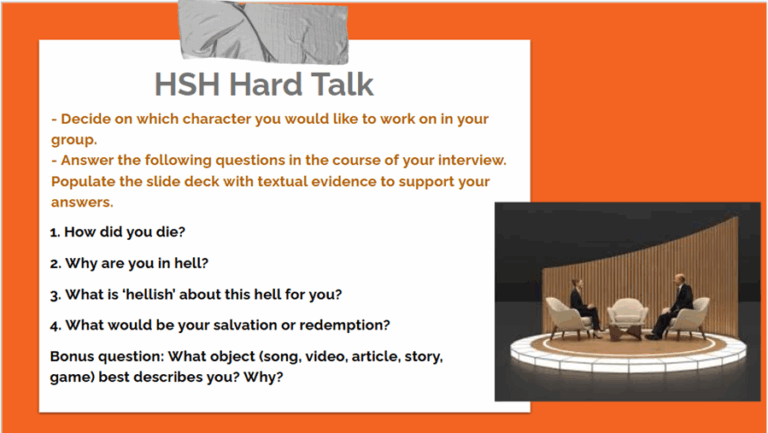
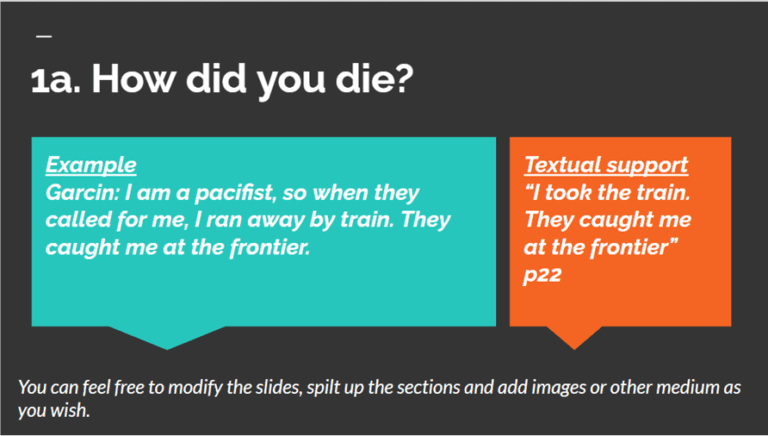
In groups of five, students are tasked with hosting a Talk Show. One student would take on the role of the host, to interview a key character in the play, enacted by another student. To deepen their engagement of the text, students are also tasked to incorporate and enact a significant “flashback” scene from the playscript into the Talk Show. To scaffold their learning, a slide template with suggested sample interview questions and pointers to consider in drafting the character’s answer is provided. Students are given time in class to discuss and work. The slides also serve as a backdrop for the Talk Show. (See Figures 1 and 2 below). For the group presenting, it works as a teleprompt; but for other groups listening, it is a visual aid that helps them follow and reflect on the discussion.
.
.
Most students were engaged and enjoyed the session: they adopted different personalities, creatively employed various gestures and tones, and engendered a fun and light-hearted atmosphere in class. The ‘role-playing’ in the Talk Show provided a deeper experience of the text, as students internalised the lines, embodied the emotions, and enacted the tensions and dynamics between the characters in the play. Students are stimulated to go beyond passively ‘reading’ the text or doing a search for answers to assigned prompt questions; they actively collaborated, acted and ‘lived’ the text. Through this process, they are nudged to develop their own interpretation, ask more of their questions, and arrive at their “own considered thoughts”. Due to time constraints, some of their Talk Shows exhibited gaps and lacked ‘polish’. Nevertheless, it remained a meaningful and enjoyable process in which students collaborated to co-create knowledge and took ownership of their learning through supportive learning relationships.
Endnotes
- The concept of a “flipped” or “inverted classroom” was first introduced in higher education by Lage, M. J., Platt, G. J., & Treglia, M. (2000), in their article “Inverting the classroom: A gateway to creating an inclusive learning environment”.
- “No Exit” is a play written by Jean Paul Sartre in the aftermath of World War II, most known for the famous line “Hell is Other People”.
Reference
Lage, M. J., Platt, G. J., & Treglia, M. (2000). Inverting the classroom: A gateway to creating an inclusive learning environment. The Journal of Economic Education, 31(1), 30–43. https://doi.org/10.1080/00220480009596759