
FOO Maw Lin1, and MUN Lai Yoke2
1Department of Chemistry, Faculty of Science (FoS), National University of Singapore (NUS)
2Department of Economics, Faculty of Arts and Social Sciences (FASS), NUS
Sub-Theme
Building Professional Relationships
Keywords
Professional relationship, interdisciplinary course, electric vehicles
Category
Lightning talk
Interdisciplinary Courses (IDCs) are a new class of courses in the core curriculum at the College of Humanities and Sciences (CHS), National University of Singapore (NUS). Instead of being discipline-based, IDCs are thematic-based. For a holistic coverage of the course theme, they are typically co-taught by lecturers from different disciplines. Since lecturers from different Departments typically have limited prior acquaintances, establishing robust professional relationships are critical (Daniel et al., 2018) for them to successfully design and co-teach a new IDC.
This lightning talk describes how professional relationships between the two authors, one from the Department of Chemistry, Faculty of Science (FoS), the other from the Department of Economics, Faculty of Arts and Social Sciences (FASS) were built using a proposed TEAMS framework to collaborate for co-teaching an IDC, HS2904 “Driving Towards the Future: Battery Electric Vehicles (BEVs)”. The TEAMS framework stands for “Trust”, “Effective Communication”, “Alignment”, “Mutual Respect”, and “Shared Responsibilities”. TEAMS aims to provide a practical framework to guide pedagogy.
Trust is the cornerstone for the development of professional relationships, especially in the context of co-teaching an IDC, where each instructor’s teaching strengths and weaknesses are revealed in the shared instructional space to both the instructors and students for comparison (Lock, 2016). It has to be built, maintained, and reinforced.
Effective Communication between instructors should be open, frequent, and timely (Daniel et al., 2018). This ensures that problems such as class administration, issues related to students’ learning, and group dynamics are addressed.
Alignment of learning intended learning outcomes, teaching and learning activities, and assessment is essential for pedagogical coherence (Biggs, 1996). For IDC, alignment through designing backwards is necessary so that students are properly scaffolded in making connections of various concepts across disciplines (Chew 2021). In HS2904, the spiral approach (Bruner, 1960) was utilised where each lecturer revisited and reinforced key concepts covered by the other.
Mutual Respect for each other’s expertise and strengths is important to negotiate differences in expectations, teaching styles, and disciplinary perspectives (Lock, 2016). In co-teaching, conflict and disagreement are inevitable, and successfully reaching a resolution can in fact strengthen the professional relationship.
Shared Responsibility signifies that instructors are jointly responsible for students’ learning, a key dimension in team-teaching (Decuyper et al., 2023). This includes providing feedback to students’ work in progress, co-grading, and jointly conducting classes.
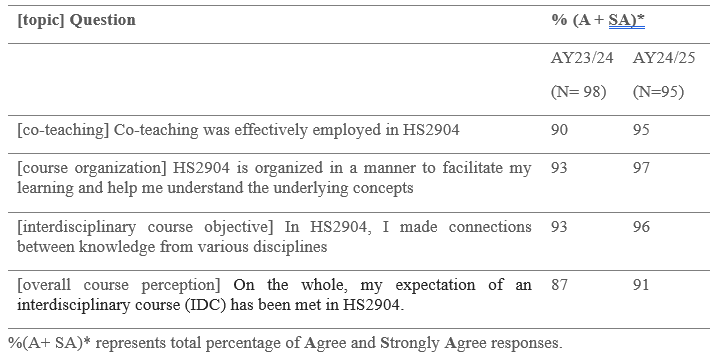
The strong professional relationship established by the lecturers fostered student engagement and course satisfaction, as manifested by the end-of-semester student surveys conducted in AY 2023/24 and AY 2024/25 (Table 1). This is consistent with the findings by Rooks (2022), that students notice and respond to the quality of collaborative interactions between co-lecturers in interdisciplinary courses. In addition, qualitative comments were also favourable. For example, one student noted, “The teaching team is engaging and very approachable, which makes the IDC less daunting for students in CHS.” Another remarked on the pedagogical integration achieved: “Very good integration of the chemistry and economics concepts to understand more about EVs. Content was engaging, and a really interesting subject[sic].”
Selected questions from end-of-semester survey for HS2904
.
Scores for all questions were consistently high for AY 2023/24 and improved in AY 2024/25. As a testament to the course planning, a large majority of the students were positive about the organisation of HS2904 regarding their learning and understanding. Students were generally positive about the effectiveness of the two lecturers’ co-teaching. For the learning objectives of IDCs as connecting different disciplinary perspectives, students scored both aspects for HS2904 highly. Lastly, across both years, 87% or more of the students indicated that their expectations of an IDC were met in HS2904.
The TEAMS framework, with essential elements for building robust professional relationships, has empowered two educators from FoS and FASS to design and co-teach HS2904, a new IDC that integrates multidisciplinary perspectives for holistic treatment of the BEV ecosystem. Due to synergy between the two authors from two different Faculties, this interdisciplinary course was perceived by students to be organised, connected, and integrated. The professional connections built from HS2904 enhanced both the educators’ professional development and students’ learning experiences.
.
References
Biggs, J. (1996). Enhancing teaching through constructive alignment. Higher Education, 32(3), 347-364. https://doi.org/10.1007/BF00138871
Bruner, J. S. (1960). The process of education. Harvard University Press.
Chew, J. (2021). Siloed in breaking silos: A case study of interdisciplinary curriculum (mis)alignment. In E. Bohemia, L. M. Nielsen, L. Pan, N. A. G. Z. Börekçi, & Y. Zhang (Eds.), Learn X Design 2021: Engaging with challenges in design education (pp. 489–498). Shandong University of Art & Design, Jinan, China. https://doi.org/10.21606/drs_lxd2021.02.231
Daniel, M. M., Ross, P., Stalmeijer, R. E., & de Grave, W. (2018). Teacher perspectives of interdisciplinary coteaching relationships in a clinical skills course: A relational coordination theory analysis. Teaching and Learning in Medicine, 30(2), 141–151. https://doi.org/10.1080/10401334.2017.1384381
Decuyper, A., Tack, H., Vanblaere, B., Simons, M., & Vanderlinde, R. (2023). Collaboration and shared responsibility in team teaching: a large-scale survey study. Education Sciences, 13(9), 896. https://doi.org/10.3390/educsci13090896
Lock, J., Clancy, T., Lisella, R., Rosenau, P., Ferreira, C., & Rainsbury, J. (2016). The lived experiences of instructors co-teaching in higher education. Brock Education: A Journal of Educational Research and Practice, 26(1), 22–35. https://doi.org/10.26522/brocked.v26i1.482
Rooks, R. N., Scandlyn, J., Pelowich, K., & Lor, S. (2022). Co-teaching two interdisciplinary courses in higher education. International Journal for the Scholarship of Teaching and Learning, 16(2), Article 8. https://doi.org/10.20429/ijsotl.2022.160208