

Kate Sangwon LEE1,*, Li Hong Idris LIM1, Narayanan Bharadwaj Manasi2, and Tang Kok ZUEA1
1 Engineering Design and Innovation Centre, College of Design and Engineering (CDE), National University of Singapore (NUS)
2 Department of Electrical and Computer Engineering, CDE, NUS
Sub-Theme
Building Technological and Community Relationships
Keywords
Generative AI, design thinking, higher-order thinking, creative learning, ethical use
Category
Paper Presentation
Introduction
With the widespread adoption of Generative Artificial Intelligence (GenAI) tools, design thinking courses in higher education face both opportunities and challenges. Using GenAI, students can explore more innovative solutions (Saritepeci & Yildiz Durak, 2024; Stige et al., 2023) and enhance their creative problem-solving skills (Elfa & Dawood, 2023). Students can incorporate GenAI into design thinking courses at various stages to maximise its technological benefits (Huang et al., 2024). These expected benefits increase students’ engagement in the design thinking process and enhance skills such as prototyping (Wadinambiarachchi et al., 2024). While GenAI can augment individual creativity, it might also lessen the authenticity of novel content (Doshi & Hauser, 2024). To address this challenge, this study explores how GenAI influences students’ creativity and problem-solving skills in design thinking courses at NUS, focusing on the research question: “How does the integration of GenAI in design thinking courses impact students’ creativity and problem-solving abilities?”
Methodology
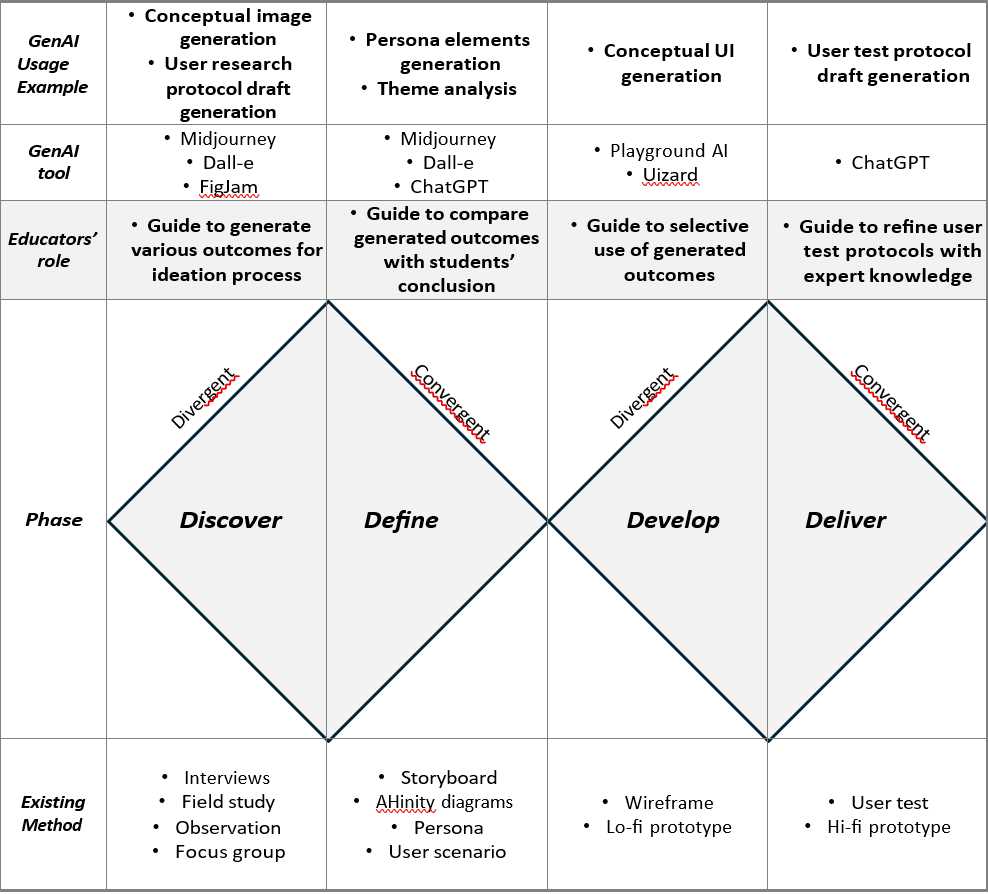
GenAI interventions were developed for the design thinking course, CDE2300 “Product Design and Innovation”, from January to April 2025, and 65 students participated in the study. In the Week 4 class, we conducted a workshop and introduced GenAI interventions at various design stages (Discover, Define, Develop, Deliver), as shown in Figure 1. These interventions included role-playing, generating personas, ideating creative solutions, and exploring prototyping, as illustrated in Figure 2.
Our research data was collected through:
- Week 1 baseline survey with 45 students to assess creative confidence and higher-order thinking with GenAI tools.
- Focus group interviews with 14 student teams (49 students) and five lecturers in Week 13

(Top left: roleplaying, top right: idea generation, Below: Prototyping)
Key Findings
Baseline Survey
50% of the students believe that GenAI can enhance their digital competence. They recognised the limitations of GenAI, such as factual inaccuracy (93.3% agreement) and limitations in handling complex tasks (88.9% agreement). They showed moderate scores in questions assessing AI’s ability to improve creativity (Mean=3.49) and higher-order thinking (Mean=3.62), which was lower than their average perception of GenAI’s capabilities (Mean=4.15).
Focus Group Interviews
From the thematic analysis of our transcription, we identified five key insights:
- AI as a creative catalyst, not creator: Students found GenAI particularly useful for inspiration in the initial ideation phase, as it helped broaden their perspectives and generate diverse ideas: “can just be a catalyst, [it] can generate a bunch of ideas…So it can spark something in you” (P1 from Team 6).
- Quantity-based ideation support: AI helped generate large volumes of ideas during the convergent phases (Discover and Develop). Students found AI helpful when they “couldn’t think of anything, and then it [GenAI] helped us generate a lot of ideas” (P2 from Team 14).
- Saving time and efficiency: Students appreciated that GenAI helped them save time and increase the efficiency of their work (“it kind of sped up the process” – P3 from Team 7)
- Higher order thinking skills needed: Students who engaged iteratively with AI outputs, refining prompts, critiquing AI suggestions, and synthesizing ideas, demonstrated increased levels of critical thinking.
- Ethical concerns: They raised issues about over-reliance on AI (“there’s definitely a possibility of misinformation if we are over reliant on AI outputs” – P4 from Team 7), including impacts on academic integrity and authorship, which require institutional guidance on ethical limits.
Conclusion
GenAI can boost creativity and higher order thinking in design education if appropriately guided. Future efforts will focus on developing policies and guidelines for the critical use of AI.
References
Elfa, M. A. A., & Dawood, M. E. T. (2023). Using Artificial Intelligence for enhancing human creativity. Journal of Art, Design and Music, 2(2), Article 3. https://doi.org/10.55554/2785-9649.1017
Doshi, A. R., & Hauser, O. P. (2024). Generative AI enhances individual creativity but reduces the collective diversity of novel content. Science Advances, 10(28). https://doi.org/10.1126/sciadv.adn529
Huang, K-L., Liu, Y-C., Dong, M-Q., & Lu, C-C. (2024). Integrating AIGC into product design ideation teaching: An empirical study on self-efficacy and learning outcomes. Learning and Instruction, 92, 101929. https://doi.org/10.1016/j.learninstruc.2024.101929
Saritepeci, M., & Durak, H. Y. (2024). Effectiveness of artificial intelligence integration in design-based learning on design thinking mindset, creative and reflective thinking skills: An experimental study. Education and Information Technologies, 29(18), 25175-25209 https://doi.org/10.1007/s10639-024-12829-2
Stige, Å., Zamani, E. D., Mikalef, P., & Zhu, Y. (2023). Artificial Intelligence (AI) for user experience (UX) design: A systematic literature review and future research agenda. Information Technology & People, 37(6), 2324-2352. https://doi.org/10.1108/ITP-07-2022-0519
Wadinambiarachchi, S., Kelly, R. M., Pareek, S., Zhou, Q., & Velloso, E. (2024). The effects of generative AI on design fixation and divergent thinking. Association for Computing Machinery, 1-18, Article 380. https://doi.org/10.1145/3613904.3642919