

Sub-Theme
Building Learning Relationships
Keywords
Students-as-Partners (SaP), teaching assistants, curriculum co-design, authentic learning
Category
Paper Presentation
Introduction
“Engaging students and staff effectively as partners in learning and teaching is arguably one of the most important issues facing higher education in the 21st century” (Healey et al, 2014). Many educators invest significant time preparing course materials, selecting readings and designing engaging classroom activities. However, the role of Teaching Assistants (TAs) who are often central to the teaching ecosystem, is rarely positioned within a pedagogical framework of partnership. This paper presentation draws on the Students-as-Partners (SaP) approach to reimagine TA-lecturer relationship as a form of collaborative teaching and curriculum co-design.
In my Tembusu College senior seminar UTS2114 “Technologies and Ageing in Singapore”, I encountered challenges that limited students’ engagement with the course material. While students recognised the importance of ageing issues, many struggled to connect emotionally or practically with the lived experiences of elderly. This disconnection often resulted in limited class participation or surface-level reflections.
To address this, I drew inspiration from Duah and Croft’s (2011) work on student-staff partnerships in course design, where student interns created materials that reflected peer learning challenges. I adopted a similar approach with six undergraduate TAs who were former students in my course, embedding the principles of co-creation and mutual learning into our collaboration. Using the SaP framework from Healey et al. (2014), our collaboration focused on learning, designing and developing of curriculum content. Together, we identified several areas where students typically disengaged or struggled to relate.
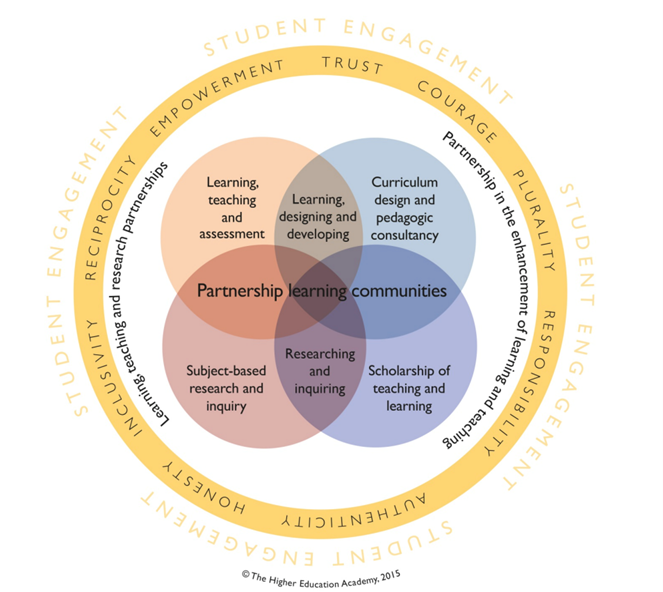
(Source: HE Academy [2015] adapted from Healey et al. [2014, p. 25])
We began the semester with individual meetings to align expectations and identify each TA’s interests. These ranges from ageing suit, fieldwork-based learning, dementia care, UI/UX design for elderly and end-of-life conversations. This was inspired by responsive teaching practices, which “involves a teacher adapting what and how they are teaching in direct response to listening to students’ ideas, interests and needs” (Bovill, 2020).
TAs were empowered to lead segments of classroom activities, reflecting the SaP principle of shared responsibilities. TAs received formative feedback on their facilitation, and in turn, shared their reflections that informed further iterations.
One TA for instance, co-designed a lesson plan on dementia, supported by a screening of The Father. The topic was deeply personal as she was caring for a grandparent with dementia. The experience not only enriched the class discussion but also transformed her own perspectives. The activity “made me a more empathetic individual, sensitive to the needs of others, especially the elderly.” The lesson sparked meaningful class discussions and enhanced student engagement. Several students reflected on the broader societal implications, with one noting the lack of support for foreign domestic workers who are often the primary caregivers. Many students shared that the session helped them understand the “importance of greater empathy” towards individuals living with dementia and those around them. This highlights how meaningful partnerships are not limited to pedagogical contributions but can also transformed sense of self and self-awareness for TAs (Cook-Sather et al., 2014; Bovill et al., 2011) and students.
Conclusion
In conclusion, reimagining TA engagement through SaP provides a scalable model for co-creating deeper learning experiences. It challenges traditional hierarchies and unlocks opportunities for deeper engagement, authentic leadership, and pedagogical renewal. As we continue to pursue excellence in teaching, we must also invest in growing our students, not just as learners but as empowered co-educators and partners in teaching and learning.
References
Bovill, C. (2020). Co-creating learning and teaching: Towards relational pedagogy in higher education (1st ed). Routledge. https://doi.org/10.4324/9781041054597
Bovill, C., Cook-Sather, A., & Felten, P. (2011). Students as co-creators of teaching approaches, course design and curricula: Implications for academic developers. International Journal for Academic Development, 16(2), 133-145. https://doi.org/10.1080/1360144X.2011.568690
Cook-Sather, A., Bovill, C., & Felten P. (2014). Engaging Students as partners in learning and teaching: A guide for faculty. John Wiley & Sons Inc.
Duah, F., & Croft, T. (2011). Students as partners in mathematics design. In CETL-MSOR Conference 2011, 49-55. https://www.researchgate.net/profile/Francis-Duah/publication/341820193_CETL_MASOR_proceedings-2011_Version_7-Pagespdf/data/5ed5e078299bf1c67d328585/CETL-MASOR-proceedings-2011-Version-7-Pages.pdf
Healey, M., Flint, A., & Harrington, K. (2014). Engagement through partnership: Students as partners in learning and teaching in higher education. York: HE Academy.
HE Academy. (2015). Framework for student engagement through partnership. York: HE Academy.