Navarun Varma
Residential College 4, University Town College Programme, National University of Singapore (NUS)
Sub-Theme
Building Learning Relationships
Keywords
Communities of learning, challenge–based learning, narrative inquiry, course development, content and pedagogical knowledge
Category
Lightning Talks
Residential College 4 (RC4) at the National University of Singapore (NUS) engages undergraduate students with the competencies needed to navigate a volatile, uncertain, complex, and ambiguous (VUCA) world (Yong & Samavedham, 2022). Central to this endeavour is research-led teaching (Chong, 2022; Brew, 2013), which can leverage Challenge-based Learning (CBL) to cultivate communities of learning, foster self-directed inquiry, and prepare students to become T-shaped professionals capable of integrating knowledge across disciplines (Höffken & Lazendic-Galloway, 2024; Gallagher & Savage, 2023). However, the diversity of disciplinary backgrounds, cultures, and interests among students poses both opportunities and challenges for collaborative research and learning (Brew, 2013).
This talk explores how cultivating multiple types of relationships—with students and external collaborators—has shaped the co-production of content knowledge, pedagogical strategies, and mutual learning experiences in RC4. Drawing on narrative inquiry (Rahman et al., 2025) and systems thinking (Sterman, 2000), the author uses a Causal Loop Diagram (Figure 1) to illustrate four relationship contexts and their influence pathways: (R1) undergraduate–graduate student–lecturer collaborations; (R2) undergraduate–external expert partnerships; (R3) formal and informal interest groups within RC4; and (R4) community engagement with non-academic stakeholders. These four types of relationships generate a self-reinforcing system of learning (Figure 1), offering a model for educators seeking to build authentic, research-led learning environments in residential colleges and beyond. However, the paper does not explore and compare the strength of the relationships.
One pathway (Figure 1 – red variables without borders) involves content generation through sustained undergraduate–graduate collaboration (R1). For example, a Year 1 student inspired by recurrent flooding in Jakarta partnered with the lecturer and a Geography master’s student to evaluate the flood mitigation policy in Indonesia for a project-based course. This collaboration resulted in a peer-reviewed publication (Sugeng et al., 2019) and contributed to new case studies and a fieldwork component in the Water Governance course of RC4. The partnership also expanded to include PhD students, fostering friendships with RC4 students, and enhancing research–teaching integration while building capacities for teaching and learning of Systems Thinking in real-world contexts.
Another pathway bridges research, content, and pedagogy (Figure 1 – blue variables with red borders – Research to Pedagogy and Research to Content loops) via external expert networks (R2). After a field trip to Singapore’s Stamford Detention Tank, a Year 2 student and the lecturer explored flood risk modeling under deep uncertainty, drawing on a network of geologists, policy scholars, and social ecologists. Together, they conceptualised Systems Thinking and System Dynamics Modeling (STSDM) as a tool for learning and experimentation (boundary object) across governance actors in data-scarce ecosystems like the Himalaya region (Figure 2a). This shaped the student’s academic trajectory—leading to graduate studies abroad—and informed participatory modeling assignments and role-play pedagogy (Figure 2b). This research has been published and embedded into the Water Governance course (Varma et al., 2025).
The third pathway (Figure 1 – green variables with violet borders – Continuous feedback loop) highlights how formal and informal interest groups (R3) fuel continuous feedback and content innovation. Alumni and senior students contribute directly to teaching through case study sharing and mentoring (Figure 2c). Funding from the PVO Gift Fund supported the creation of a Cognito Pod in RC4 and informal groups like the SFI Brains, which helped convert the Jakarta case into a serious game. These communities serve as vital testing grounds for pedagogical refinement. For instance, acting on their feedback, formal tests were replaced with student journaling to better capture learning from fieldwork to model building.
Finally, boundary objects co-created with R3 proved useful for learning with community partners in residential programs (R4, Figure 2d). Such efforts led to co-authored conference presentations (Baruah et al., 2023) and publications under review, as well as a novel pedagogical approach to the Water Governance course and associated teaching resources (Figure 1 – Interest-Pedagogy and Interest-Content loops).
These interconnected pathways illustrate how relationship-rich ecosystems (Felten & Lambert, 2020) can effectively implement principles of CBL. For instance, they can facilitate communities of learning—such as the bonding between graduate and RC4 students in R1 or the interactions within SFI brains in R3. They also support self-directed inquiry, as seen in the Year 2 students’ transition in R2, and help prepare T-shaped professionals with integrative skills, exemplified by the development of teaching, research, and collaborative capacities among students from R1 to R4. The example of RC4 highlights that by integrating research, teaching, and community engagement through systems thinking, we can reimagine higher education for a VUCA world.

.
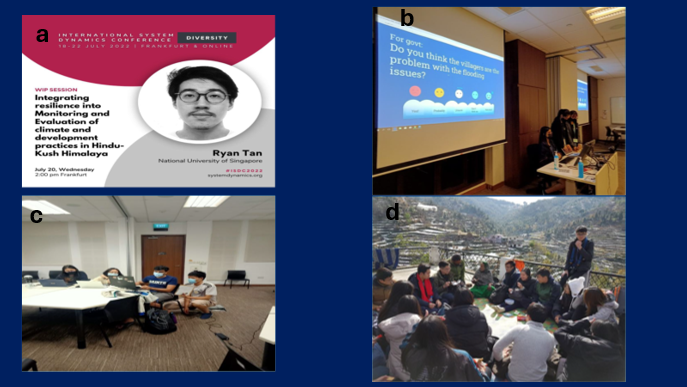
(b) The role play pedagogy inspired by research within R2,
(c) RC4 alumni and NUS-PhD student mentoring a RC4 cohort in class, and
(d) Application of participatory modeling method—as boundary object in RC4 STEER Himalaya
.
References
Baruah, A. G., Ng, G, Varma, N., & Fathin, C. A. (2025). Migration as anticipatory governance: Pathways, policies, and practices in a changing climate. Paper presented at the International Conference on Public Policy (ICPP7), Chiang Mai, Thailand. International Public Policy Association. Available online at: https://www.ippapublicpolicy.org/conference/icpp7-chiang-mai-2025/panel list/21/panel/adopting-anticipatory-governance-systems-perspective/1693
Brew, A. (2010). Imperatives and challenges in integrating teaching and research. Higher Education Research & Development, 29(2), 139–150. https://doi.org/10.1080/07294360903552451
Felten, P., & Lambert, M. (2020). Relationship-rich education: How human connections drive success in college. Johns Hopkins University Press.
Gallagher, S. E., & Savage, T. (2020). Challenge-based learning in higher education: An exploratory literature review. Teaching in Higher Education.
Höffken, J., & Lazendic-Galloway, J. (2024). Engaging for the future: Challenge-based learning and stakeholder partnerships in sustainability education. Sustainable Earth Reviews, 7(20). https://doi.org/10.1186/s42055-024-00087-6
Rahman, N., Cobb, H., Giddings, L., Truglia, M. H., Dolan, S., Jhangiani, S., & O’Connor, K. (2025). Context matters: Enhancing SoTL by exploring interpersonal relationship building in higher education. Teaching & Learning Inquiry, 13, 1–20. https://doi.org/10.20343/teachlearninqu.13.23
Sterman, J. D. (2000). Business dynamics: Systems thinking and modeling for a complex world. McGraw-Hill.
Sugeng, E. S., Varma, N., & Smith, Z. A. (2019). Evaluation of the Normalisasi Policy in Jakarta, Indonesia using system dynamics. Landscape Architecture Frontiers, 7(3), 78–93. http://dx.doi.org/10.15302/J-LAF-1-020005
Toh, T. C. (2022). From specialist to teacher-scholar: The influence of SoTL on the journey of an early career academic. Asian Journal of the Scholarship of Teaching and Learning, 12(1), 88–95. https://doi.org/10.24112/ajsotl.123164
Varma, N., Tan, R., Wasson, R. J., Tortajada, C., Rakshit, R., & Saikia, A. (2025). From discourses to systems—Policymaking for adaptive management in the Brahmaputra River basin. Environmental Research Letters, 20(6). https://iopscience.iop.org/article/10.1088/1748-9326/add02b
Yong, B. C., & Samavedham, L. (2022). Building public policy capacity through systems thinking and system dynamics modeling education in an undergraduate residential college setting. In S. Nair & N. Varma (Eds.), Emerging pedagogies for policy education: Insights from Asia (pp. 81–98). Springer.