

Kelvin TAN Cheng Kian1*, and CHOW Siew Hoong2
1S R Nathan School of Human Development, Singapore University of Social Sciences (SUSS)
2Educational Media and Resources, SUSS
Sub-Theme
Building Technological and Community Relationships
Keywords
Virtual reality, immersive technology, engagement, technology, eldercare community, older persons, training
Category
Lightning Talks
Introduction
This paper presents the exploratory study conducted on the use of Virtual Reality (VR) technology to train students to engage older persons in the eldercare community.
Amid the growing popularity of 360-degree immersive contents and applications coupled with the higher affordance of VR devices, the use of VR technology in the field of education is a viable complement in traditional classroom. “Technology in an Ageing Society” is a leading SUSS graduate course which teaches students on use of technology to improve the quality of life of older persons and their carers. Conducting an exploratory study on the use of VR technology for students in this course complements the key learning outcome. Students can examine the factors that contribute to the success of techno-gerontological solutions, design and improve geron-technology applications that address health, rehabilitation, disability and caregiving concerns.
Method
This study uses a digital platform to host 360-degree content recorded with an Insta360 camera to create an immersive experience. The multimedia contents were captured during the Chinese New Year Chingay Parade 2025, supported by the People’s Association, digital photographs, and narrative text.
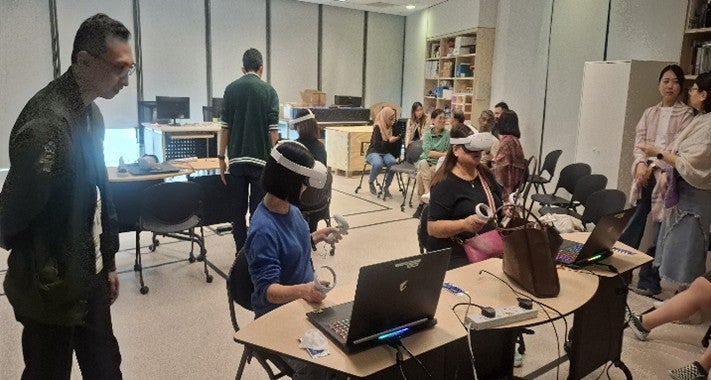
Participants were briefed on the setup and safety precautionary measures. Throughout the study, they sat on the chairs and enjoyed up to 10 minutes of the VR content. At any one time, the participants were supported by technical assistants from SUSS. If anyone felt uncomfortable from VR sickness (Geršak et al, 2020), the headsets will be removed.
50 students from three cohorts (2023 to 2025) of the “Technology in Ageing Society” course were selected for this study. The post-intervention interviews were conducted in focus group format to elicit their responses as a training tool for use in the eldercare community.
Findings
The participants provided some useful feedback during the post-intervention interview:
- Keep the text content to minimum to reduce fatigue of the eyes from extended wearing.
- Use large font in the contents for better visual effect.
- Insert number for every scene for easy follow of the sequence during navigation.
- Place the content including videos, images and text in the VR environment within eye view range to mitigate giddiness.
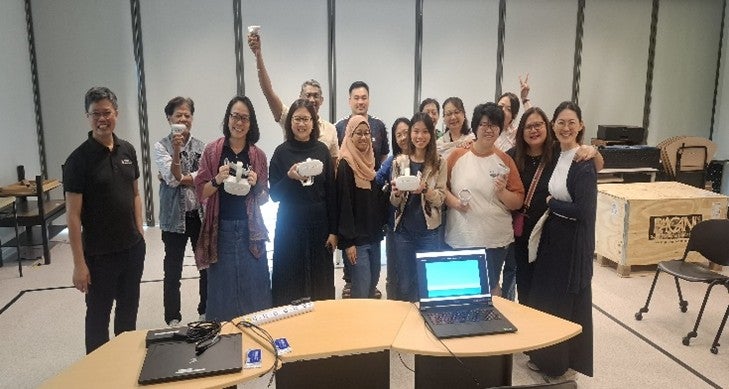
Overall, the collective results of this intervention were positive. The 360° VR Chingay Parade video “teleported” the participants into the event with the effect of watching the event Live. Through the virtual experience, it evoked recollections of festive activities with family members and friends. There is a sense of happiness as they enjoyed mental wellness and relaxation, and opened up new conversations with their peers. Additionally, the physical movement of hands and neck during the intervention improved the psychomotor capability of students.
.
.
Limitations
It was noted that the VR experience was still relatively new to some students. A few of them were initially hesitant in wearing the headsets. The instructors and assistants played an important part in assisting the students with clear instructions and timely explanation.
Some participants reported that the headsets is relatively heavy and resulted in discomfort to their neck and shoulder, and a few experienced giddiness after wearing the devices for more than 10 minutes.
Conclusion
VR intervention is a potential training tool for students to complement classroom learning for the eldercare community. Immersive experience with relevant contents can support the reminiscence and lived experiences.
For students who aspired to become facilitators with older persons in the eldercare community, they learnt the potential positive outcomes on the mental, physical and social impact on the VR user.
The findings from the exploratory study created new pathway for future researchers to investigate and formulate a VR development training plan with practical guidelines and technical specifications to integrate into future classroom.
References
Choukou, M.-A., Zhou, J., & Gao, Q. (2023). Immersive VR for training cognition in seniors with neurological disorders. In Human Aspects of IT for the Aged Population (Vol. 14042, pp. 522–530). Springer. https://doi.org/10.1007/978-3-031-34866-2_37
Fuchs, P., Moreau, G., & Guitton, P. (2011). Virtual reality: concepts and technologies (1st edition). CRC Press. https://doi.org/10.1201/b11612
Geršak, G., Lu, H., & Guna, J. (2020). Effect of VR technology matureness on VR sickness. Multimedia Tools and Applications, 79(21–22), 14491–14507. https://doi.org/10.1007/s11042-018-6969-2
Guazzaroni, G. (Ed.). (2019). Virtual and augmented reality in mental health treatment. IGI Global. https://doi.org/10.4018/978-1-5225-7168-1
Saville, J. D., Foster, L., ProQuest Information and Learning Company., & North Carolina State University. (2023). Virtual Reality Learning Self-Efficacy : Does the Topic of VR Training Matter? ProQuest LLC.