

LAM Siew Hong, and LIM Xin Xiang
Department of Biological Sciences, Faculty of Science (FoS), National University of Singapore (NUS)
Sub-Theme
Building Professional Relationships
Keywords
Learning Community, Discipline-based education research, collaboration, professional development, enhancing teaching and learning
Category
Paper Presentation
The growing emphasis on improving Science, Technology, Engineering, and Mathematics (STEM) education has underscored the importance of Discipline-Based Education Research (DBER), which integrates disciplinary expertise with pedagogical knowledge, cognitive sciences, and the scholarship of teaching and learning (National Research Council, 2012; Henderson et al., 2017). However, STEM educators frequently encounter challenges when engaging in DBER, notably sustaining the “will” (motivation), developing “skills” (research capability and support), and experiencing “thrills” (intrinsic and extrinsic rewards) necessary for continued engagement (Coppola & Krajcik, 2017; Sunal et al., 2001) (Figure 1).
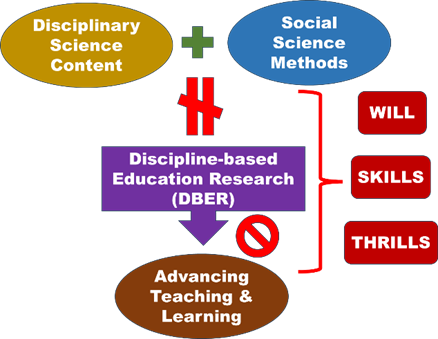
To address these challenges, we established a learning community consisting of 12 educator-track academics within the Department of Biological Sciences, Faculty of Science, National University of Singapore (NUS). An initial survey was conducted to identify members’ DBER interests and challenges. The findings informed the formation of three thematic clusters: student engagement, assessment and feedback, and AI or technology-enhanced learning. Based on these themes, educators worked collaboratively in smaller groups to design and implement context-specific projects aligned with their areas of interest.
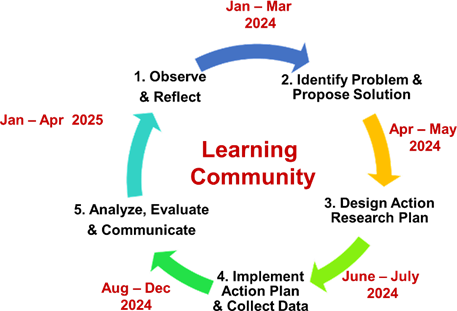
From January 2024 to June 2025, we had 14 structured meetings designed to facilitate DBER engagement and professional growth (Figure 2). The community employed an iterative action research framework, facilitating a continuous cycle of observation and reflection in order to identify teaching challenges and proposed solutions, intervention design and implementation, followed by subsequent data collection and analysis (Norton, 2018). Throughout the one-and-a-half-year cycle, the community meetings served as pivotal interaction sessions for collaborative progress sharing, discussion of pedagogical challenges, and iterative feedback on study designs and data analyses. These sessions emphasized collective reflection and supported the adaptation of research strategies to members’ diverse teaching contexts. Moreover, the meetings provided a platform for participants to refine their research questions, troubleshoot methodological challenges, and share preliminary findings.
.
Within the 1.5 years, we have launched eight education research projects, presented ten education conference papers, obtained two internal grants, and submitted one external grant for review. To assess the impact of the learning community, a follow-up survey was conducted after 1.5 years, revisiting challenges initially identified in the pre-learning community survey. The findings revealed substantial improvement in perceptions of collaboration opportunities and access to research support. Members expressed an enhanced sense of connection and highlighted the emergence of new research partnerships and co-developed studies. Additionally, the community facilitated professional development of the learning community members through shared resources and workshops on pedagogical research methods. Participants reported increased confidence in applying educational theories and research methodologies to their teaching, supported by a stronger sense of collegiality and shared purpose. This underscores the importance of fostering academic communities to address feelings of isolation and lack of support, which are often major barriers to DBER engagement (van Lankveld et al., 2017; Henderson et al., 2017).
Overall, the structured approach of setting up an action research learning community within a department, anchored in iterative action research and collaborative peer interactions, proved instrumental in equipping STEM educators with the necessary “will,” “skills,” and “thrills” to engage in DBER. The design and operation of this community offer a replicable model for advancing professional development and educational research capacity among university educators in the same department or same discipline, thereby contributing to sustained improvements in STEM teaching and learning.
Acknowledgement
Our learning community was supported by the Teaching Enhancement Grant (TEG) under the Centre for Teaching, Learning and Technology (CTLT), NUS. We thank Profesor Yu Hao, the Head of Department of Biological Sciences, for his support for our Learning Community.
References
Coppola, B. C. & Krajcik, J. S. (2013). Discipline-centered postsecondary science education research: Understanding university level science learning. Journal of Research in Science Teaching, 50(6), 627-638. https://doi.org/10.1002/tea.21099
Henderson, C., Connolly, M., Dolan, E. L. Finkelstein, N., Franklin, S., Malcom, S., Rasmussen, C., Redd, K., & John, K. S. (2017). Towards the STEM DBER Alliance: Why we need a discipline-based STEM education research community. International Journal of STEM Education, 4(14). https://doi.org/10.1186/s40594-017-0076-1
Schweingruber, H. A., Nielsen, N. R., & Singer, S. R. (Eds.). (2012). Discipline-based education research: Understanding and improving learning in undergraduate science and engineering. National Academies Press.
Norton, L. (2018). Action Research in Teaching and Learning: A Practical Guide to Conducting Pedagogical Research in Universities (2nd ed.). Routledge. https://doi.org/10.4324/9781315147581
Sunal, D. W., Hodges, J., Sunal, C. S., Whitaker, K. W., Freeman, L. M., Edwards, L., Johnston, R. A., & Odell, M. (2001). Teaching science in higher education: Faculty professional development and barriers to change. School Science and Mathematics, 101(5), 246-257. https://doi.org/10.1111/j.1949-8594.2001.tb18027.x
van Lankveld, T., Schoonenboom, J., Volman, M., Croiset, G., & Beishuizen, J. (2017). Developing a teacher identity in the university context: A systematic review of the literature. Higher Education Research & Development, 36(2), 325–342. https://doi.org/10.1080/07294360.2016.1208154