

TRAN Phuoc My*, ZHANG Hao Dong, and Anand BHOJAN
School of Computing (SOC), National University of Singapore (NUS)
Sub-Theme
Building Learning Relationships
Keywords
Experiential learning, authentic learning, project-based learning, computing education, project showcase
Category
Paper Presentation
Introduction
The School of Computing Term Project Showcase (STePS) at the National University of Singapore (NUS) is a biannual academic-industry event that has been a cornerstone of the computing curriculum for over 13 years. Each semester, 60 to 100 project teams from upper-level undergraduate and postgraduate modules present their capstone and coursework-based projects to faculty, alumni, industry professionals, and peers. More than a showcase, STePS align with its E³ motto—Education, Employment, and Entrepreneurship—serving as a platform that bridges academic learning with industry expectations. This paper explores how STePS foster authentic and experiential learning, supporting key computing program outcomes such as communication, collaboration, and applied problem-solving.
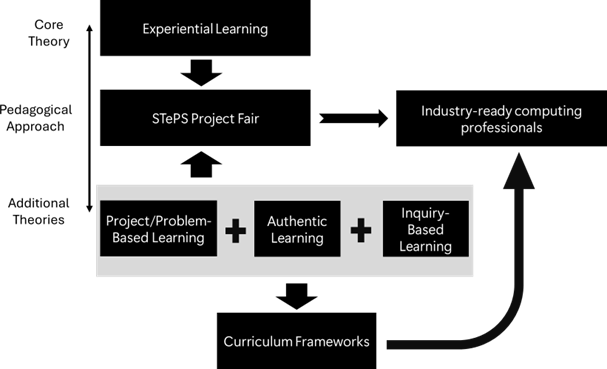
STePS are underpinned by Experiential Learning theory (Kolb, 1984), which posits that learning is a process driven by experience, reflection, conceptualization, and experimentation. Students engage in hands-on project development, reflect during presentations and feedback sessions, and refine their work based on insights gained. This process is enhanced by pedagogical tools such as Project/Problem-Based Learning (Wijnia et al., 2024), Authentic Learning (Herrington et al., 2004), and Inquiry-Based Learning (Pedaste et al., 2015). The event’s effectiveness is assessed against established curriculum frameworks, including ABET (2025), CDIO (2023), and Association for Computing Machinery (ACM) (Kumar et al., 2023), which emphasise the development of industry-ready professionals. Figure 1 summarises the relationship between the pedagogical theories that underpin STePS, and the curriculum frameworks and outcomes that STePS align towards.
.
This study investigates three research questions:
- How does STePS enhance experiential and project-based learning in computing education?
- In what ways does STePS contribute to authentic assessment practices?
- To what extent does STePS align with program-level learning outcomes as defined by ABET and ACM (Kumar et al., 2024)?
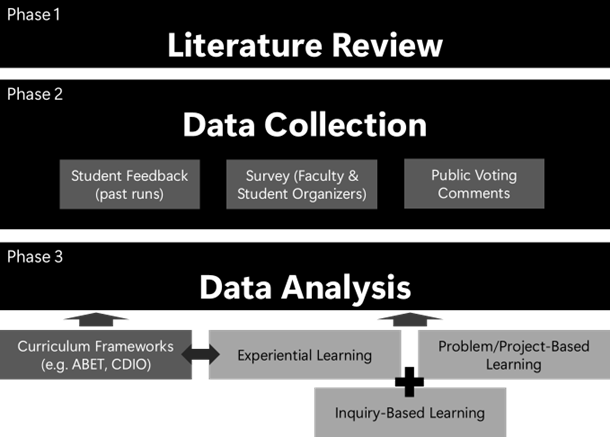
A mixed-methods approach was utilised, analysing survey data from the 18th to 26th STePS events. Feedback was collected from student exhibitors, organisers, and faculty staff through surveys and qualitative responses. Both quantitative and qualitative analyses were conducted to evaluate alignment with theoretical frameworks and learning outcomes. Figure 2 summarises our methodology.
.
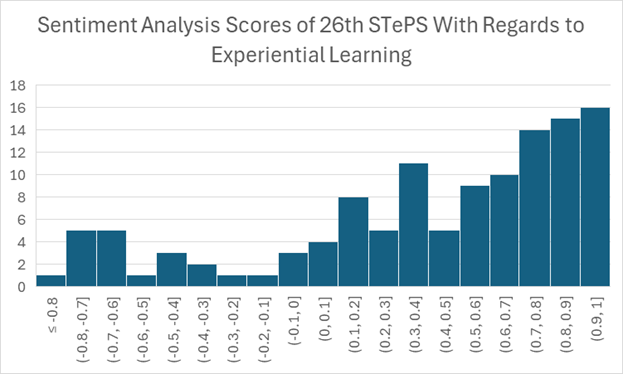
Findings demonstrate that STePS align strongly with Experiential Learning theory. Over 85% of exhibitors from the 26th STePS reported that the event enhanced their understanding of computing concepts, citing benefits from debugging, user feedback, and iterative development. One student remarked, “It helped me understand how users interact with the system and refine features accordingly,” reflecting Kolb’s concrete experience and reflective observation phases (Kolb, 1984). Public feedback also expresses positive sentiments regarding peer-to-peer learning. One reads, “Study buddy enforces real-world application and connects human interaction to the best of their capability. The project encourages peer-to-peer learning, and it proves beneficial to the community”. A faculty member further remarks, “Over the years, I have used STePS as a vehicle for motivating students to have a more holistic view and practice of their technical curriculum […]”, aligning strongly with the value of Experiential Learning. The public showcase, involving industry judging and peer feedback, supports experiential learning, with students valuing its real-world applicability. We performed sentiment analysis via the “cardiffnlp/twitter-roberta-base-sentiment-latest” model for free-text responses, combined with normalised Likert-scale responses, which give a mean of 0.398 for experiential learning alignment over n=119 student responses. Table 1 gives the questions used, and Figure 3 summarises the overall scores.
Survey questions to Exhibitors at the 26th STePS
| Reflecting on the project showcase event, how did hands-on experiences contribute to your learning? |
| Did engaging in real-world tasks and challenges deepen your understanding of the subject matter? |
How did the process of reflecting on your experiences during the project impact your learning outcomes? |
| Did the project showcase event encourage you to think critically and solve problems creatively? |
Did the project showcase event help you develop skills such as teamwork, communication, and project management? |
How effective do you think the assessment methods used in the project showcase event were in evaluating your learning and skills? |
Did receiving feedback from peers, teachers, or experts during the event help you understand your strengths and areas for improvement? |
In what ways did the authenticity of the assessment tasks in the project showcase event align with your learning goals and experiences? |
Did the event provide opportunities for you to pursue topics or areas of interest that motivated you to engage more deeply? |
What aspects of the project showcase event did you find most valuable in terms of your learning and development? |
Are there any areas of the event that you feel could be improved to enhance the learning experience for future participants? |
How likely are you to recommend participating in similar project showcase events to other students based on your experience? |
| Did the event encourage you to learn from peers? (e.g. viewing other projects, evaluating other projects, etc.) |
What did you learn from peers from same course and other courses participating in STePS this round and in previous rounds? |
| Any other comments on your learning journey, project, and STePS? |
.
.
STePS also align with ABET and ACM (Kumar et al., 2024) outcomes, particularly in communication and teamwork. Students developed skills in pitching ideas to diverse audiences and collaborating across roles, meeting ABET Outcome 3 (communication) and Outcome 5 (teamwork) (ABET, 2025). The event further inspired motivation, with students pursuing additional projects and tackling open-ended challenges.
This study highlights STePS as an integrative learning space that bridges theory and practice, fostering relationships among students, educators, and industry professionals. It contributes to the conference theme, “Building Relationships in Teaching and Learning,” by showcasing how experiential and authentic practices enhance computing education and prepare students for industry. These insights offer a model for curriculum designers aiming to cultivate professional readiness and lifelong learning.
.
References
ABET. (2025). Criteria for accrediting computing programs, 2025-2026.
Kumar, A. N., Raj, R. K., Aly, S. G., Anderson, M. D., Becker, B. A., Blumenthal, R. L., Eaton, E., Epstein, S. L., Goldweber, M., Jalote, P. Lea. D., Oudshoorn, M., Pias, M., Reiser, S., Servin, C., Simha, R., Winters, T., & Xiang, Q. (2024). Computer science curricula 2023. Association for Computing Machinery, New York, NY, United States. https://doi.org/10.1145/3664191
Benware, C. A., & Deci, E. L. (1984). Quality of learning with an active versus passive motivational set. American Educational Research Journal, 21(4), 755–765. https://doi.org/10.3102/00028312021004755
Brown, T., & Katz, B. (2011). Change by design. Journal of Product Innovation Management, 28(3), 381-383. https://doi.org/10.1111/j.1540-5885.2011.00806.x
Crawley, E. F., Malmqvist, J., Östlund, S., Brodeur, D. R., & Edström, K. (2014). Rethinking engineering education: The CDIO approach, second edition. Springer International Publishing.
Ryan, R. M., & Deci, E. L. (2000). Self-determination theory and the facilitation of intrinsic motivation, social development, and well-being. The American Psychologist, 55(1), 68–78. https://doi.org/10.1037/0003-066x.55.1.68
Dhanalakshmy, D. M., & Murali, R. (2024). Can technical festivals help in attaining undergraduate engineering programme outcomes?. 2024 IEEE International Conference on Teaching, Assessment and Learning for Engineering (TALE), 1-5. https://doi.org/10.1109/TALE62452.2024.10834350
Fincher, S., & Petre, M., & Clark, M. (2001). Computer science project work: Principles and pragmatics. Springer London.
Hamari, J., Koivisto, J., & Sarsa, H. (2014). Does gamification work? — A literature review of empirical studies on gamification. 2014 47th Hawaii International Conference on System Sciences, 3025-3034. https://doi.org/10.1109/HICSS.2014.377
Herrington, A., & Herrington, J. (2006). Authentic learning environments in higher education. Idea Group Inc.
Herrington, J., Reeves, T., & Oliver, R. (2004). Authentic learning environments in higher education. IGI Global.
Kolb, D. A. (1984). Experiential learning: experience as the source of learning and development. Prentice-Hall.
Lombardi, M. M. (2007). Authentic learning for the 21st century: An overview. EDUCAUSE Learning Initiative. http://alicechristie.org/classes/530/EduCause.pdf
Pedaste, M., Mäeotos, M., Siiman, L. A., de Jong, T., van Riesen, S. A. N., Kamp, E. T., Manoli, C. C., Zacharia, Z. C., & Tsourlidaki, E. (2015). Phases of inquiry-based learning: Definitions and the inquiry cycle. Educational Research Review, 14, 47–61. https://doi.org/10.1016/j.edurev.2015.02.003
Schank, R. C. (1995). What we learn when we learn by doing. Northwestern Institute, Institute for Learning Sciences.
Topping, K. J. (2005). Trends in peer learning. Educational Psychology, 25(6), 631–645. https://doi.org/10.1080/01443410500345172
Wiggins, G. (1990). The case for authentic assessment. Practical Assessment, Research, and Evaluation, 2(1). https://doi.org/10.7275/ffb1-mm19
Wijnia, L., Noordzji, G., Arends, L. R., Rikers, R. M. J. P., & Loyens, S. M. (2024). The effects of problem-based, project-based, and case-based learning on students’ motivation: A meta-analysis. Educational Psychology Review, 36. https://doi.org/10.1007/s10648-024-09864-3
Worldwide CDIO Initiative. (n.d). http://cdio.org/
Zilora, S. J., et al. (2011). The undergraduate research symposium as a capstone experience. In Proceedings of ACM ITiCSE, 201–205.