

Kaelynn YAP*, and Chloe OH
Department of Philosophy, College of Humanities and Sciences (CHS), National University of Singapore (NUS)
Sub-Theme
Building Learning Relationships
Keywords
Student apathy, moral dialogue, framework-based learning
Category
Lightning Talk
Student apathy, characterised by low levels of learning motivation, classroom preparation and engagement, is a persistent challenge faced by educators regardless of locality or field (Ryan et. al., 2015; West, 2024). Educators have responded by exploring innovative classroom strategies, such as drawing out information from students via peer-group case interactions, using social-emotional strategies to evoke and address personal reactions, or leveraging new technologies to boost engagement (Tammeleht et al., 2019; West, 2024; Zakaria et al., 2020). Corroborating with Lineweaver (2010) and Ryan et. al.’s (2015) struggle with disengaged students, our students similarly exhibited signs of reluctance or disconnectedness towards social issues and each other. This talk builds upon existing strategies to explore how structuring student relationships underlying moral dialogue can help overcome apathy in the ethics classroom. The classroom-based ethical framework aims to provide educators facing similar issues with a viable way to increase personal stake in the classroom, incentivising sincere and enduring interest over apathy.
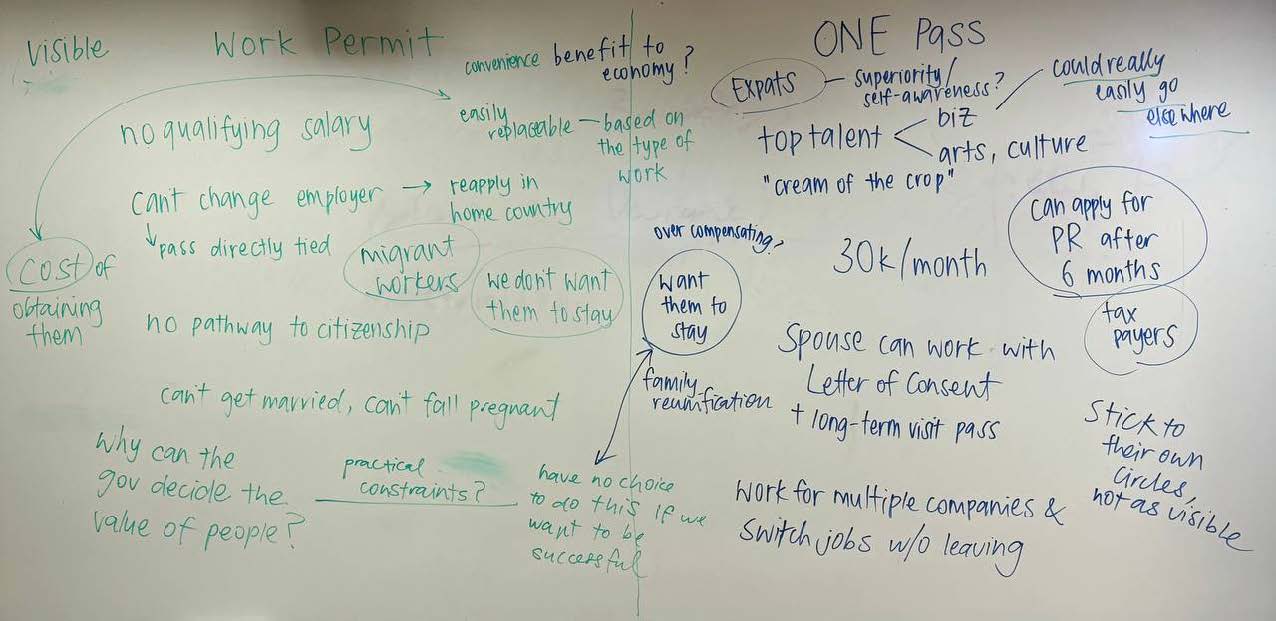
This is based on our experience teaching an undergraduate-level ethics course (GESS1029 “Everyday Ethics in Singapore”). One domain that saw the highest student inertia was the migration segment of the course. Singapore’s migration regime offers a unique case that challenges students to consider the political, social, and economic conditions of a demographic that they are largely disconnected from. With the migration-specific activity as an example, we extend our experience into a generalisable framework suitable for wider use in other courses covering social issues.
.
Students compile a list of conditions governing the entrance and stay of employment pass and work permit holders, comparing them side-by-side on a central collaborative space. With the instructor occupying a facilitative role, students are prompted to consider possible reasons for these rules and its variations from an economic and socio-political lens. Students are then encouraged to contribute lived, everyday experiences to refine each others’ personal convictions. This activity yielded positive response in feedback exercises from former students whose initial apathy towards migration developed into a deeper concern and appreciation through this activity. The effect was particularly pronounced in students who reported limited content knowledge on abstract migratory issues. We largely attribute this to the application of the local context coupled with positive peer interaction increasing the relatability and comprehensibility of complex concepts.
In line with Bloom’s Taxonomy, the general framework undergirding the above activity encourages learning via the following goal hierarchy: (1) Understand–increase awareness of structural and regulatory frameworks; (2) Analyse–draw comparisons and identify moral distinctions across social groups and; (3) Evaluate–establish personal convictions through peer-to-peer dialogue. Within the broader ethics landscape, our framework seeks to provide students with sufficient structure to push productive discussion when a growing disconnect may otherwise stumble. It also promotes students’ agency to freely exchange ideas, empathise with others’ experiences and take ownership of their beliefs. Structuring space to share everyday experiences makes ethical discussions regardless of discipline more accessible to the unfamiliar, allowing students of all backgrounds and competency levels to participate.
.
References
Lineweaver, T. (2010). Online discussion assignments improve students’ class preparation. Teaching of Psychology , 37(2), 204-209. https://doi.org/10.1080/00986283.2010.488546
Ryan, C., Moss, S. E., & Moss, J. (2015). Attacking classroom apathy. Academy of Educational Leadership Journal, 19(3), 281–288. https://www.abacademies.org/articles/AELJ_Vol_19_No_3_2015.pdf
Tammeleht, A., Rodríguez-Triana, M. J., Koort, K. & Löfström, E. (2019). Collaborating case-based learning process in research ethics . International Journal for Educational Integrity, 15(6). https://doi.org/10.1007/s40979-019-0043-3
West, S. (2024). Overcoming student apathy through innovative technology, Engagement, and social emotional strategies. Journal of Instructional Research, 13 , 5–19. https://files.eric.ed.gov/fulltext/EJ1442000.pdf
Zakaria, N. S., Saripan, M. I., Subramaniam, N. & Ismail, A. (2020). Assessing Ethoshunt as a gamification-based mobile app in ethics education: Pilot mixed-methods study. JMR Serious Games, 8(3). https://games.jmir.org/2020/3/e18247/