
HO Han Kiat
Department of Pharmacy and Pharmaceutical Sciences, Faculty of Science (FoS), National University of Singapore (NUS)
NUS College
Office of Student Affairs (OSA), NUS
Sub-Theme
Building Learning Relationships
Keywords
Hormesis, authentic teaching and learning, team-based learning, building relationships
Category
Paper Presentation
Introduction
Authentic pedagogy is a universal principle that seeks to connect the learners to the real world (Christmas, 2014). This helps to create a sense of meaning and relevance, which drives intrinsic motivation for the learners. In this reflective piece, I attribute the value of building authentic relationships between the teacher and the learners (and with each other) as a differentiating factor for this pedagogy. These insights are gleaned from the design and delivery of an interdisciplinary course NST2057 “Hormesis and Life”, for NUS College students.
The Teaching Context
Hormesis is a toxicological principle that expounds on the recurring phenomenon of “what doesn’t kill you makes you stronger”. It advocates that controlled amount of stress acting on a system can trigger an adaptive response which leads to beneficial outcomes (Calabrese et. al., 2016). Importantly, there are biological mechanisms that rationalise this effect. Drawing from this theory as the cornerstone, the objective for this course is for students to interrogate this phenomenon across various contexts and disciplines and ultimately shape them to view life adversities with renewed perspectives and courage.
Building Relationship and Connectivity Through the Content
The entry point for building a relationship with the students through the course is to help everyone uncover for themselves how this teaching context is relevant to their real world. At the onset, the introductory lecture brings out multiple phenomena in daily lives to make this connection real (e.g. hormesis in muscle building and immunisation) [Figure 1]. Through these examples, it communicates the authenticity of the content and forges a common understanding to connect people despite hailing from different academic disciplines.
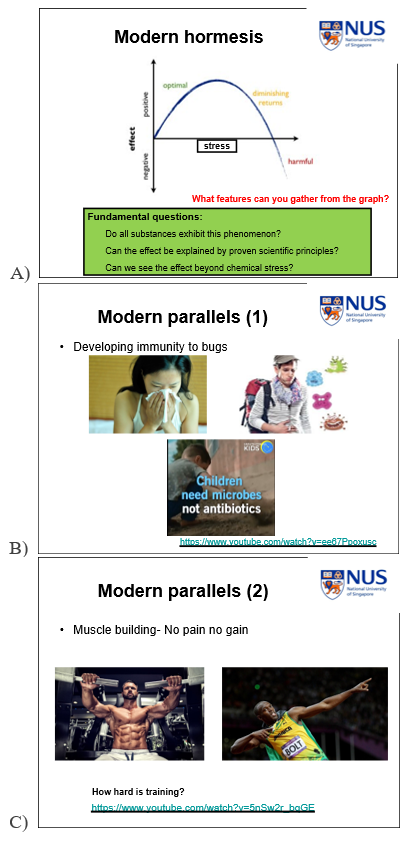
A) This figure illustrates the core principle of hormesis. To demonstrate that it is a common phenomenon in the real world;
B) stress in the form of attenuated bugs is used for vaccination; whereas
C) stress in the form of weights is required for muscle building
.
To enhance this authentic connection with the learners, I articulated my dual role as a teacher and a learner. I expressed the inherent challenge that the design of this course compels me to explore the applicability of hormesis beyond what is already known. Therefore, I would have to circumvent my knowledge gaps especially in distal domains (e.g. exploring hormesis in areas of economics and social sciences).
Building Relationship Through a Formative Team-based Learning
The diversity of disciplinary backgrounds for NUS College students creates natural learning communities that thrive on the exchange of ideas and experiences. Hence, I fostered an interdisciplinary learning and relationship building through setting criteria for team-based group presentations, whereby members of each team must comprise at least two contrasting Schools/Faculties. To turn this arrangement into a formative learning journey, I created a mid-term sharing of group presentation ideas, whereby students present their unique illustrations of hormesis, and the rest of the class will challenge the illustrations based on their own appreciation of hormesis principles. This approach leverages on trust, respect, and mutual accountability. The more the students ask constructive questions, the sharper and more refined would be their eventual ideas of hormesis.
Building Relationship Through Exchange of Personal Insights
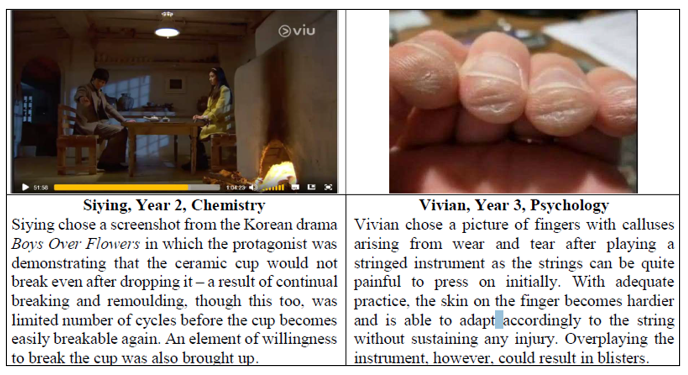
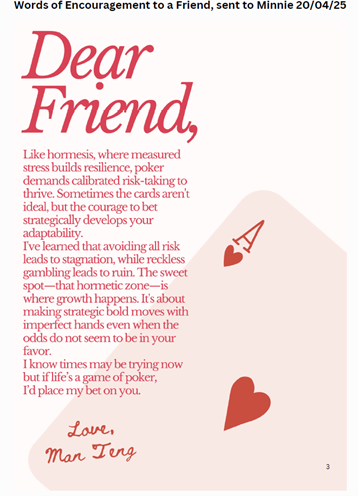
Finally, I created distinct opportunities for the sharing of personal insights to foster learning connections. In the early part of the semester, I first shared a pictorial illustration of hormesis and then asked each student to find an equivalent that communicates the same idea. This created a unique platform for creative sharing of insights and to give them a glimpse into individual perspectives and experiences (Figure 2). As part of the final individual report, I also included a component where students will write a letter of encouragement to one of their classmates, using the learning points from the course as the motivational content (Figure 3).
.
.
Conclusion and Significance
Through this course, I have learned that building learning relationships between teacher-learners and learners-learners is an effective tool to foster the authenticity of the learning environment. With further refinement, it presents the potential to further elevate the commitment of the learners and consequently, the transformative power of the content knowledge.
References
Christmas, D. (2014). Authentic pedagogy: Implications for education. European Journal of Research and Reflection in Educational Sciences, 4(2), 51-57. https://www.idpublications.org/wp-content/uploads/2014/09/AUTHENTIC-PEDAGOGY-IMPLICATIONS-FOR-EDUCATION.pdf
Calabrese, E. J., Dhawan, G., Kapoor R., Iavicoli, I., Calabrese, V. (2016) Hormesis: A fundamental concept with widespread biological and biomedical applications. Gerontology, 62, 530-535. https://doi.org/10.1159/str000441520