
Muzzammil Yassin
Centre for Language Studies (CLS), Faculty of Arts and Social Sciences (FASS), National University of Singapore (NUS)
Sub-Theme
Building Learning Relationships Between Teacher and Learner & Learner to Learner
Keywords
Teacher-learner relationships, learner-learner relationships, feedback, language acquisition, affective filters
Category
Paper Presentation
Introduction
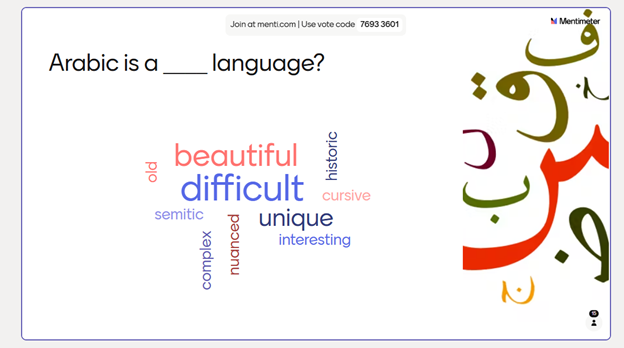
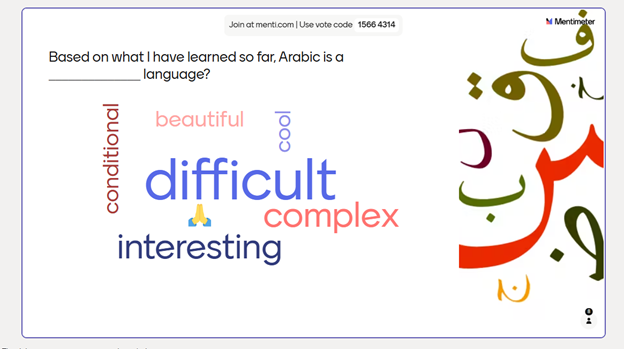
Language learning can be both fulfilling and rewarding, yet it also presents many challenges, particularly with languages that are perceived to be ‘difficult’. Students embarking on the study of such supposedly difficult languages often begin from a position of uncertainty with heightened affective filters that might hinder effective language acquisition. Data collected over more than ten consecutive semesters from the Centre for Language Studies (CLS) Arabic classrooms show that Arabic is frequently regarded as ‘difficult’ and ‘complex’, especially for beginner learners. In this context, the development of strong teacher-student and student-student relationships emerges as a cornerstone in helping learners overcome perceived difficulties, thereby contributing to positive language learning outcomes. Such rapport enables our students to better manage the academic rigour of Arabic courses offered at National University of Singapore (NUS).
.
This presentation highlights two key mechanisms that foster rapport and create a positive atmosphere in Arabic classrooms at NUS:
- Providing students with feedback and,
- Creating a fun, safe learning environment for them.
Questions to be addressed
- How was feedback used as a relational tool to promote effective learning, build rapport, and reduce anxiety throughout the course?
- How did classroom structures and interactive activities contribute to the development of student-student relationships, and how did these, in turn, contribute towards creating a conducive environment for language acquisition in the classroom?
Findings
In this presentation, feedback is featured not only as a tool for correction, but also to support learners’ progress, boost confidence, enhance motivation, and reduce anxiety (Hyland & Hyland, 2006; Poulos & Mahony, 2008; Shute, 2008). Data from student feedback reports and teacher observations highlight the central role of feedback in providing CLS Arabic students with emotional safety, increasing their sense of ‘being seen and supported’ by their teacher. Results from student feedback reports show that students consistently report high levels of trust and support. They also show that feedback possibly plays a role in motivating them in their study of the Arabic language and establishes a bond of trust, which is cultivated over the semester.
Another aspect is peer relationships, which are fostered through the creation of a vibrant and interactive classroom environment. Activities, such as conversation exercises, interviews, and reverse crossword puzzles, play a pivotal role in helping students feel comfortable with their classmates. Student voices also show that our students feel comfortable exploring new aspects of the language without the fear of making mistakes, an outcome attributed to both the positive support and feedback provided by the teacher and the inclusive, enjoyable classroom atmosphere.
The relationships developed throughout the semester in the various Arabic courses at CLS reflect the qualities of an effective language learning environment and align with what has long been affirmed in Second Language Acquisition (SLA). As Krashen (1982) mentions, “the language class should be a place where anxiety is low, and students feel secure and motivated.”
Significance for Language Education
Student testimonies reveal that the dual pillars of effective learning relationships – personalized, effective feedback and an interactive, inclusive classroom – are not simply ‘extras’ that are advantageous to have in a learning environment. Instead, they are essential foundations for learning relationships that enable deep learning and inspire and motivate our students. Although well established in the literature on second and foreign language acquisition, the importance of cultivating such environments may sometimes be overlooked. As Krashen (1982) notes:
“Attitudes and emotions are related to second language acquisition. Performers with high motivation, self-confidence, a good self-image, and a low level of anxiety are better equipped for success in second language acquisition.”
The data further demonstrates that classroom practices such as games, group work, and humor contribute to creating a safe space where students feel comfortable making errors and grow in their learning journey. As a result, students consistently report feeling motivated and inspired, enjoying the journey of learning despite perceiving Arabic as a language that is challenging to learn. The supportive learning relationships developed through the journey of the course also enabled the lecturer to maintain academic rigor while simultaneously providing students with the necessary scaffolding to meet challenges they may encounter in their learning.
References
Hyland, K., & Hyland, F. (2006). Feedback on second language students’ writing. Language Teaching, 39(2), 83–101. https://doi.org/10.1017/S0261444806003399
Krashen, S. (1982). Principles and practice in second language acquisition. Pergamon Press Inc.
Poulos, A., & Mahony, M. J. (2008). Effectiveness of feedback: The students’ perspective. Assessment & Evaluation in Higher Education, 33(2), 143–154. https://doi.org/10.1080/02602930601127869
Shute, V. J. (2008). Focus on formative feedback. Review of Educational Research, 78(1), 153–189. https://doi.org/10.3102/0034654307313795