

Eunice S. Q. NG1*, LIM Cheng Puay1, and Stephen En Rong TAY2
1Ridge View Residential College (RVRC), National University of Singapore (NUS)
2Department of the Built Environment, College of Design and Engineering (CDE), NUS
Sub-Theme
Building Technological and Community Relationships
Keywords
Interdisciplinary education, sustainability education, student-generated questions, community engagement, experiential learning
Category
Paper Presentation
Students’ motivation to participate in community engagement influences the depth of their interactions and the formation of meaningful community relationships. Self-determination theory (SDT) highlights autonomy—the need for choice and control over one’s behaviour—as a key influence on students’ motivation to engage in learning activities (Ryan & Deci, 2000, 2017). Lovett et al. (2023) also suggest that students are more motivated when learning is relevant to their interests. Accordingly, aligning learning activities with students’ need for autonomy and interests can enhance students’ motivation to learn and encourage deeper community engagement.
To this end, we implemented the Contextualised Learning via Enquiring, Answering, and Reflection (CLEAR) approach (Lund University, 2025) in the course RVN2000 “Engaging Communities in Sustainability” at Ridge View Residential College (RVRC). This approach empowers students to formulate questions, pursue personally meaningful lines of inquiry, and reflect on their findings regarding the role of communities in sustainability. It leads students to utilise higher orders of the Bloom’s taxonomy in reflecting on their community engagement experiences (Bates et al., 2014; Paul & Elder, 2007). Hence, we explore the following questions:
- Does CLEAR deepen students’ learning on sustainability?
- How does CLEAR impact students’ motivation in community engagement?
Methodology
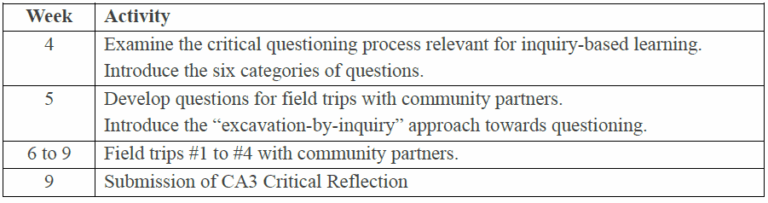
In Academic Year 2024/25, the course developed students’ questioning skills to enhance their critical thinking competency, which was assessed through a critical reflection (CA3).
Scaffolded approach to developing students’ questioning skills
.
In Semester 1, students interviewed a community stakeholder and reflected on insights gathered to develop a personal response (CLEAR’s ‘Answering‘ and ‘Reflection‘). In Semester 2, CA3 was revised to begin with students formulating a sustainability-related question (CLEAR’s ‘Enquiring‘), allowing them to define the topic according to their interests. A post-course survey was administered in Semester 2, and student work was compared across semesters.
Results
1. Student Learning
Figure 1 indicates an improvement in the quality of CA3 assignments. There was notable reduction in the number of students scoring in the lower mark ranges, with the mode mark increasing from 70 (Semester 1) to 74 (Semester 2). Qualitative feedback showed that CLEAR “is the most impactful for learning and applying critical thinking, as we have to extract insights and formulate our own thoughts”. Another student shared that enquiring “was pretty useful since we had to think critically about what questions to ask… (and) focus our questions to answer specific questions”. Semester 2 students were observed to pose more focused interview questions, in contrast to more generic questions by Semester 1 students.
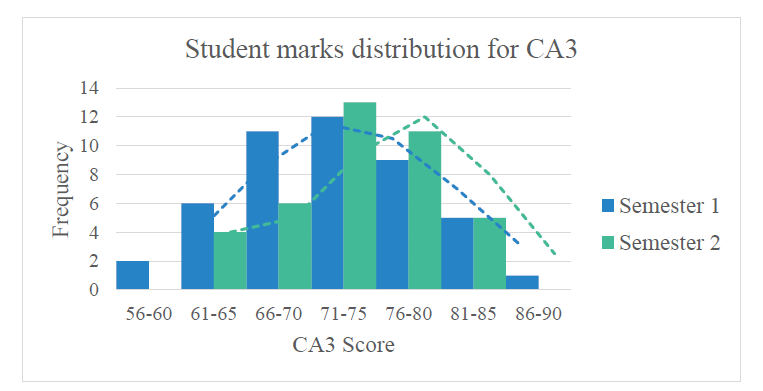
Figure 1. A comparison of CA3 student scores across two semesters in AY2024/25.
.
Across semesters, students shared how their assumptions towards sustainability issues were challenged, with a student reflecting on how she “realised that my initial question had oversimplified the issue”. This indicates that students were engaging higher-order thinking skills, such as synthesis and evaluation, in their exploration of sustainability.
2. Student Motivation
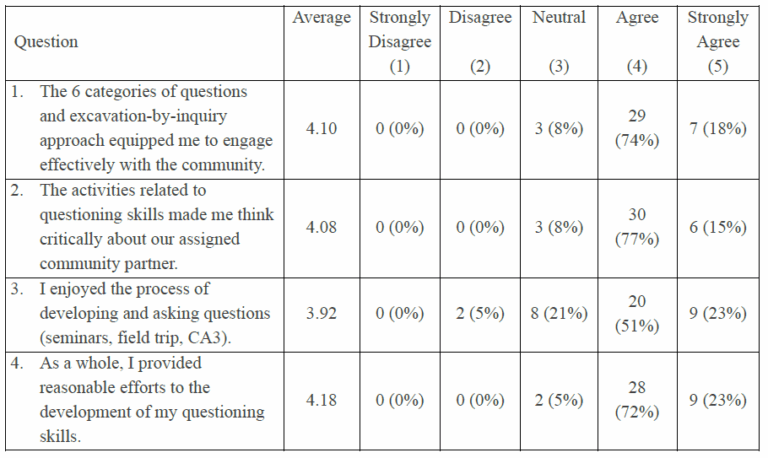
Generally, students reported enjoying the CLEAR process and perceived its value for community engagement (Table 2). Interestingly, some students reported a neutral or negative response on their level of enjoyment yet made efforts to develop their questioning skills. According to SDT, students may be engaging in identified regulation, in which they engage in the task because of its value and importance even if it is not inherently enjoyable (Guay, 2022).
Semester 2 post-course survey on developing questioning skills on a 5-point Likert scale (n = 39)
.
Conclusion
By developing students’ questioning skills and aligning assessment design with students’ interests and need for autonomy, applying CLEAR has demonstrated its potential to enhance student learning and motivation to engage communities in sustainability. While a comparison with a control cohort was not possible, these preliminary results suggest that CLEAR is effective for fostering community engagement and critical thinking in sustainability education. As it does not require capital investment, educators can easily adopt CLEAR and scale it across larger courses.
.
References
Bates, S. P., Galloway, R. K., Riise, J., & Homer, D. (2014). Assessing the quality of a student-generated question repository. Physical Review Special Topics-Physics Education Research, 10(2), 020105. https://doi.org/10.1103/PhysRevSTPER.10.020105
Guay, F. (2022). Applying self-determination theory to education: Regulations types, psychological needs, and autonomy supporting behaviors. Canadian Journal of School Psychology, 37(1), 75-92. https://doi.org/10.1177/08295735211055355
Lovett, M. C., Bridges, M. W., DiPietro, M., Ambrose, S. A., & Norman, M. K. (2023). How learning works: Eight research-based principles for smart teaching. John Wiley & Sons.
Lund University. (2025). Contextualised Learning via Enquiring, Answering, and Reflecting: Experiences at National University of Singapore. Retrieved June 10 from https://www.education.lu.se/en/calendar/contextualised-learning-enquiring-answering-and-reflecting-experiences-national-university-singapore
Paul, R., & Elder, L. (2007). Critical thinking: The art of Socratic questioning. Journal of Developmental Education, 31(1), 34-37. http://www.jstor.org/stable/42775642
Ryan, R. M., & Deci, E. L. (2000). Self-determination theory and the facilitation of intrinsic motivation, social development, and well-being. American Psychologist, 55, 68-78. https://psycnet.apa.org/doi/10.1037/0003-066X.55.1.68
Ryan, R. M., & Deci, E. L. (2017). Self-determination theory: Basic psychological needs in motivation, development, and wellness. Guilford Press. https://doi.org/10.1521/978.14625/28806