
Ulysses Tsz Fung LAM, Reuben Manjit Singh, and YEONG Foong May*
Department of Biochemistry, Yong Loo Lin School of Medicine (YLLSOM), National University of Singapore (NUS)
Sub-Theme
Building Learning Relationships
Keywords
Supplemental videos, generative AI, replacement, students’ perception
Category
Poster Presentation
Introduction
LSM2233 “Cell Biology” is a large-class course designed to encourage independent learning and critical analysis of experimental data in biochemistry. Due to the varied biology backgrounds of students, the authors used generative artificial intelligence (AI) tools to create supplemental videos to help bridge knowledge gaps (Singh et al., 2024). Leveraging the capabilities of generative AI to support teaching and learning in higher education was aligned with the replacement level of the Replacement, Augmentation, and Transformation (RAT) model (Hughes, 2000), and enhanced educational delivery without significantly increasing instructors’ workload (Singh et al., 2024). Here, we summarised results from a mid-semester student survey, which showed generally positive feedback on supplemental videos created with the aid of generative AI
Methods
Production of Supplemental Videos
We created nine supplementary videos addressing recurring questions from previous cohorts, likely arising from students’ diverse academic backgrounds. We first prompted ChatGPT-4o to draft slide content, which we enhanced with diagrams to suit the course context (Figures 1, 2, and 3). The revised slides were then used to prompt narration scripts (Figure 2). We used an AI-generated speaker voice modeled after F.M.Y. with Descript and produced the final videos by combining slide decks, scripts, and voiceover (Singh et al., 2024).

.

.

.
Mid-semester Survey
An anonymous online mid-semester survey was administered via Google Forms during Recess Week of the Academic Year 2024/2025, Semester 1, to 238 undergraduates enrolled in LSM2233. The survey followed Level 1 (Reaction level) of the Kirkpatrick evaluation model (Kirkpatrick, 1959) and was distributed by R.M.S. through an announcement on the National University of Singapore’s Canvas, including Likert-scale questions on supplemental video usage, students’ acceptance, perceived usefulness, and alignment with preset learning objectives. An open-text question was included for additional feedback. U.T.F.L. and R.M.S. analysed the responses, processing both Likert-scale items and open-text responses using Microsoft Excel.
Results
Likert-scale Questions
Usage of supplemental videos
We received 55 responses for the Likert-scale questions. Of these, 98.2% of the respondents indicated viewing at least one AI-generated video (Figure 4). Given that students were informed that these supplemental videos were on fundamentals of cell biology and not part of the main lecture content, the responses indicated a fair level of interest and engagement with these materials.

.
Acceptance of supplemental videos
At the beginning of each supplemental video, we disclosed the use of AI assistance in its creation. In terms of the acceptance of the AI-generated narration, 90.7% of respondents found the AI-generated narration clear (Figure 5, far left), and 88.7% disagreed that it was distracting (Figure 5, left central). Also, 98.1% agreed that the video duration (5–10 minutes) was appropriate (Figure 5, right central), aligning with established guidelines for sustaining attention (Bradbury, 2016). Additionally, 88.7% of respondents expressed interest in having more AI-generated videos for topics we had yet covered by supplemental videos (Figure 5, right). The responses indicated to us a good level of acceptance among students for the use of such AI-generated videos.

.
Perceived Usefulness of Videos
Among the respondents, 96.3% indicated that the videos were helpful in reinforcing key course concepts (Figure 6, left). This corresponded with at least 90.7% of the respondents agreeing that the course objectives were clearly communicated (Figure 6, right). The positive response to the videos’ usefulness was hence based on the respondents’ good level of understanding of the course objectives.

.
Open-text Questions
.
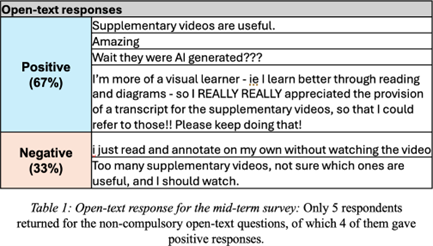
Only 6 open-text responses were returned. Four respondents concurred with the Likert scale responses and expressed positive views about the supplemental videos. One suggested that the videos were unnecessary, while another felt that the videos could be better organised.
Discussion
The findings from our student survey aligning with previous research (Chiu, 2023), support the feasibility of incorporating short, AI-assisted videos as a scalable, time-efficient supplement to traditional instruction. Despite positive feedback, a respondent found the number of supplemental videos overwhelming and struggled to identify the most relevant ones within the limited semester timeframe. Other than positive feedback, there was a comment on the overwhelming number of videos and uncertainty about which were relevant. This suggests a need for better organization of the videos, such as grouping by difficulty or linking to specific learning objectives. One student preferred a transcript due to his/her visual learning style. While transcripts could improve accessibility, they might reduce video engagement and risk spoon-feeding students, especially in an open-book course like LSM2233. Future improvements should aim to balance content delivery with diverse learning preferences.
References
Bradbury, N. A. (2016). Attention span during lectures: 8 seconds, 10 minutes, or more? Advances in Physiology Education, 40(4), 509-513. https://doi.org/10.1152/advan.00109.2016
Chiu, T. K. F. (2023). The impact of Generative AI (GenAI) on practices, policies and research direction in education: A case of ChatGPT and Midjourney. Interactive Learning Environments, 10, 1–17. https://doi.org/10.1080/10494820.2023.2253861
Hughes, J. E. (2000). Teaching English with technology: Exploring teacher learning and practice [PhD thesis]. Michigan State University.
Kirkpatrick, D. L. (1959). Techniques for evaluation training programs. Journal of the American Society of Training Directors, 13, 21-26.
Singh, R. M., Lam, U. T. F., & Yeong, F. M. (2024). Leveraging generative AI tools to produce supplemental videos: Course instructors’ reflections [Poster presentation]. In Higher Education Conference in Singapore (HECS) 2024, 3 December, National University of Singapore. https://blog.nus.edu.sg/hecs/hecs2024-rmsingh-et-al/